Rotary Cup vs Conventional Powder Spray Gun: Which Works Better for Complex Parts?
Choosing between a rotary cup and a conventional powder spray gun is not simply a question of which technology is newer or more powerful. The useful question is: which gun creates the most controllable powder cloud for your actual parts, powders, booth, and production method?
Conventional corona powder guns are widely used because they are familiar, flexible, and available in many manual and automatic configurations. A rotary cup gun approaches application differently. Instead of depending mainly on a fast pneumatic stream to form the spray pattern, it uses a rotating cup to distribute powder into a softer, broader cloud. That difference can become important when coating welded frames, channels, recesses, dense profiles, and other parts where strong air movement or edge loading makes film build difficult to control.
How a Conventional Powder Spray Gun Works
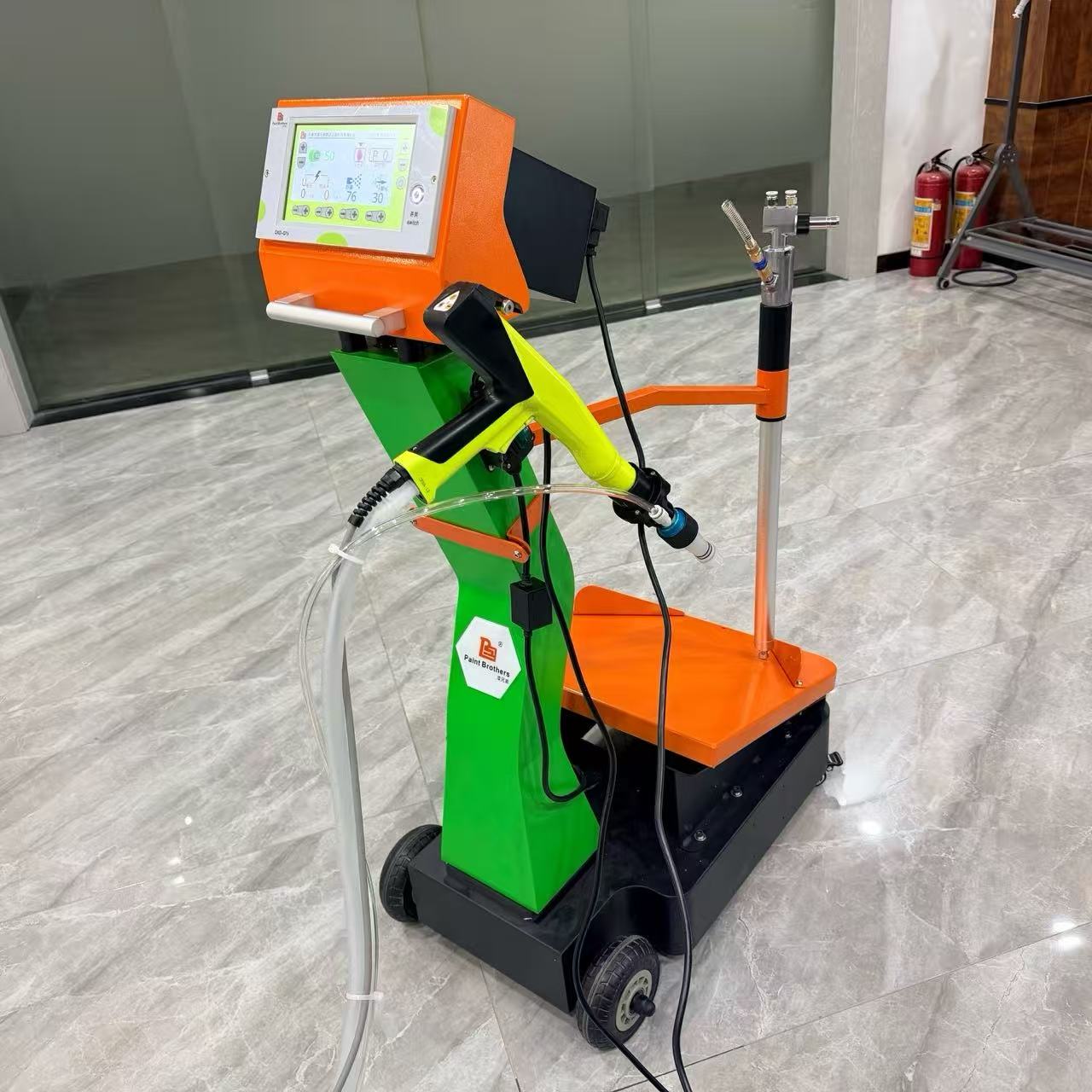
A conventional electrostatic powder gun normally receives powder from a venturi or dense-phase pump. Conveying air moves the powder through the hose, while pattern or atomizing air and the selected nozzle shape the cloud. An electrode charges the particles so they are attracted to a properly grounded workpiece.
This arrangement gives the operator direct control over powder output, air, voltage, current, nozzle type, gun distance, and travel speed. It is effective for flat panels, open frames, general fabrication, and production lines that already have stable recipes. However, when output air is too high, the plume can blow across a recess, disturb powder already deposited, or load the nearest edge before the powder reaches the deeper surface.
How a Rotary Cup Powder Gun Works
A rotary cup gun delivers powder toward a spinning cup. Rotation spreads the powder outward and forms a wide, distributed cloud. Electrostatic charging then attracts the particles to the grounded part. Because the powder pattern is formed mechanically at the cup and does not rely only on a concentrated air jet, the operator can often approach complex geometry with a softer cloud and less impact on the closest edge.
The result is not automatic perfection. Grounding, powder condition, part orientation, cup speed, powder output, voltage, current limit, gun angle, and operator technique still matter. Rotary atomization is most useful when it gives the process a larger and more stable operating window, especially on parts that repeatedly show heavy edges and light recesses with a conventional setup.
Rotary Cup vs Conventional Powder Gun: Key Differences
| Decision factor | Conventional powder gun | Rotary cup powder gun |
|---|---|---|
| Powder cloud | Shaped mainly by conveying and pattern air plus the nozzle | Distributed by the rotating cup into a broad, soft cloud |
| Open flat surfaces | Fast, familiar, and easy to configure | Good coverage, although the main advantage may be less noticeable |
| Deep corners and channels | Requires careful air, kV, current, nozzle, and angle control | Softer delivery can help reduce edge loading and support controlled penetration |
| Film-build control | Very repeatable after the recipe and gun path are stable | Useful where concentrated spray repeatedly creates heavy local buildup |
| Operator learning | Widely understood and supported | Requires training in cup speed, approach angle, distance, and powder output |
| Color change | Depends on pump, hose, gun, and booth design | Requires a validated cleaning routine for the cup and powder path |
| Best fit | General-purpose production and straightforward parts | Complex geometry, recesses, profiles, frames, and difficult manual touch-up |
Which Gun Handles Complex Parts Better?
Complex parts do not have one coating problem. A welded tube frame may contain exposed edges, tube intersections, internal corners, and shadowed surfaces. An aluminum profile may combine wide faces with narrow slots. A heat sink may have fin tips that attract powder rapidly while the roots remain light. The right gun is the one that lets the operator balance these zones without creating excessive film build elsewhere.
A conventional gun can coat difficult parts successfully when grounding is reliable, the nozzle suits the geometry, the powder cloud is not too aggressive, and separate recess and finishing passes are used. A rotary cup becomes attractive when the conventional plume repeatedly pushes powder past narrow openings or concentrates too much material on the nearest edge.
Faraday Cage Areas
Charged powder naturally follows the strongest electric field. External edges and projecting surfaces can collect powder before internal corners and recesses receive enough coverage. Simply increasing voltage may strengthen this imbalance. With either gun, the first corrections should include clean grounding, reduced output, a better attack angle, and a recess-first spray sequence.
The rotary cup's broader cloud can help the operator work across a recess instead of driving a narrow plume directly into it. That may improve consistency, but it does not eliminate the Faraday cage effect. Parameters must still be adjusted for the part, and the result should be confirmed with film-thickness checks.
Edges, Hooks, and Thin Sections
Thin sections and sharp edges charge quickly. If the powder stream is dense or the gun dwells too long, the part can develop heavy edge buildup, rough texture, or back ionization. A conventional gun may need lower output, lower electrostatic intensity, or a different nozzle. A rotary cup may provide a more even cloud around the geometry, but travel speed and overlap still need control.
Transfer Efficiency Depends on the Whole System
No gun should be judged by transfer efficiency in isolation. Grounding, rack cleanliness, powder particle distribution, reclaim ratio, booth airflow, gun distance, part spacing, conveyor speed, and operator technique all affect how much powder reaches the part. A well-tuned conventional gun can outperform a poorly set rotary cup, and the reverse is also true.
For a useful comparison, spray the same representative parts with the same powder and pretreatment. Record fresh powder use, reclaim conditions, coating time, film thickness at easy and difficult locations, touch-up time, rejects, and cleaning time. The best equipment choice is the one that lowers total coating cost while maintaining the required finish, not the one that creates the most visible powder cloud.
Film Build and Finish Quality
Both technologies can produce a smooth, durable finish when the film is applied within the powder supplier's recommended range and cured to the specified part-metal schedule. Problems appear when operators compensate for light recesses by repeatedly coating the whole part. The outer surfaces then become too thick while the deepest areas remain inconsistent.
Use separate settings or passes for different zones:
- Recess pass: lower, controlled powder delivery; suitable electrostatic intensity; angle aligned with the opening.
- Sidewall pass: approach from more than one direction to reduce shadowing.
- Finishing pass: normal overlap on open faces after difficult areas have acceptable coverage.
- Inspection: measure film at edges, faces, corners, roots, and other representative points before releasing the recipe.
Production Speed, Cleaning, and Color Change
Conventional powder guns are often the practical choice for lines that already have established pumps, hoses, controls, spare parts, and cleaning procedures. Operators can switch nozzles and recipes quickly, and maintenance teams are familiar with wear points.
A rotary cup system should be evaluated as a complete process. Cup cleaning, powder-path access, hose length, powder feed stability, spare cups, and operator training all affect uptime. For frequent color changes, conduct a real changeover trial using the colors and powders you run most often. A coating advantage on complex parts must be weighed against cleaning time and contamination risk.
When a Conventional Powder Gun Is the Better Choice
- Most parts are flat, open, or geometrically simple.
- The current line already produces stable film build and acceptable first-pass yield.
- Fast color change and broad local support are higher priorities than recess performance.
- Operators need a familiar general-purpose manual gun for many unrelated tasks.
- The main coating problem comes from grounding, pretreatment, powder condition, or curing rather than spray formation.
When a Rotary Cup Powder Gun Is Worth Testing
- Parts contain deep corners, grooves, channels, tube intersections, fins, or shadowed surfaces.
- Conventional spray repeatedly creates heavy edges and light recesses.
- A concentrated air stream disturbs deposited powder or blows across narrow openings.
- Manual touch-up is high and operators need a broader, softer cloud.
- The shop is prepared to standardize cup speed, powder output, electrostatic settings, distance, angle, and cleaning.
A Practical Equipment Trial
Do not choose from a brochure alone. Select two or three representative parts: one easy part, one typical production part, and one part that causes the most rework. Use the same powder batch and comparable booth conditions. For each gun, document setup time, coating time, powder use, film thickness by location, appearance after cure, touch-up, rejects, and cleaning.
Also ask whether one technology can cover every product family or whether a mixed strategy is better. Many factories use conventional automatic guns for open surfaces and keep a specialized manual gun for difficult areas, development work, or touch-up. The most productive solution may be a combination rather than a total replacement.
Final Recommendation
Choose a conventional powder spray gun when you need a flexible, familiar platform for straightforward parts and established production. Test a rotary cup when complex geometry, concentrated airflow, heavy edges, or repeated recess touch-up limits the current process.
QXD / Paint Brothers can evaluate your parts with the Q7 handheld rotary cup electrostatic powder coating gun. Send drawings or photos, part dimensions, difficult coating areas, powder type, target film thickness, current settings, and reject symptoms. We can recommend a comparison test, nozzle or cup setup, and a practical spray sequence for your production.
For more detailed process guidance, read Rotary Cup Powder Coating Parameters: What to Adjust First, How to Solve the Faraday Cage Effect in Powder Coating Deep Corners, and Tube and Frame Powder Coating: A Complete Guide for Metal Fabricators. You can also review the Q7 handheld rotary cup powder coating gun or contact QXD / Paint Brothers to arrange a sample spray test.