
Powder Coating Square Tubes: How to Improve Coverage on Edges and Inner Corners
Square tubes are widely used in metal fabrication because they are strong, clean-looking, and easy to weld into frames. For powder coating shops, however, square tubes bring a familiar challenge: the part looks simple from a distance, but the corners, edges, welds, and intersecting tube sections can make coating thickness inconsistent.
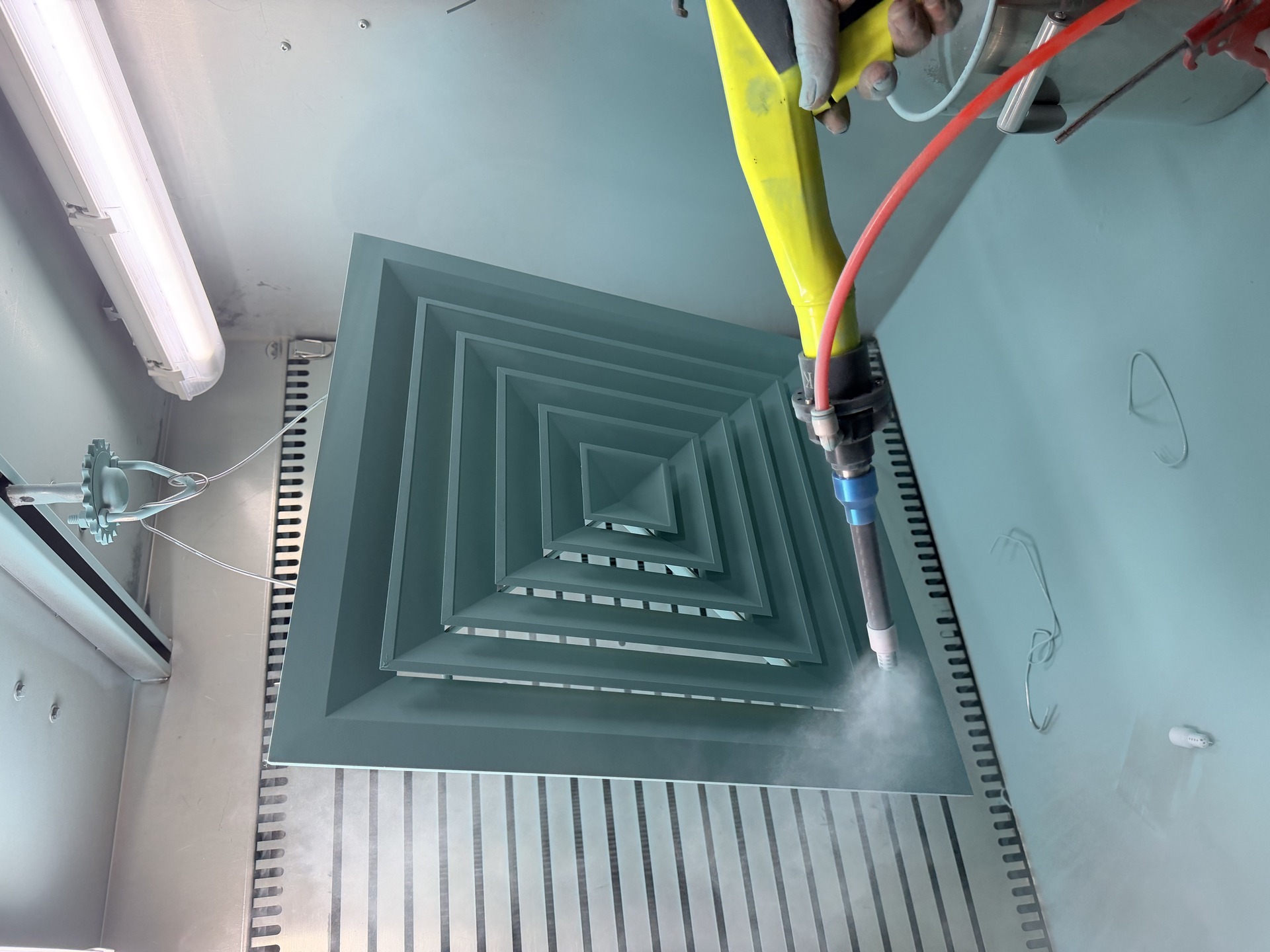
If a coating shop only increases powder output, the result is often more overspray rather than better coverage. The better approach is to understand where powder is being lost, where electrostatic attraction becomes weak, and how the operator can change the spray process before defects appear.
Why Square Tubes Are Difficult to Coat Evenly
Round tubes allow powder to wrap more smoothly around the surface. Square tubes behave differently because they have flat faces connected by sharp outside edges and 90-degree corners. Powder particles may build quickly on the first visible face while the edge, back side, or inside corner remains thin.
This is especially noticeable on welded square tube frames. At each joint, the part geometry becomes more complex: two or more tube faces meet, weld beads interrupt the surface, and small shadow areas form around the intersection. These details can reduce powder access and create a localized Faraday cage effect.
Common Coverage Problems on Square Tubes
Thin Film on Outside Edges
Sharp edges are difficult because powder tends to deposit on the flat face before enough film builds on the edge radius. During curing, powder can also flow away from the edge, making the final film thinner than expected. If the edge is too sharp, corrosion protection and appearance can suffer.
Missed Areas in Inner Corners
Inside corners between square tubes can block direct powder flow. Electrostatic attraction may pull powder to the outer surfaces first, leaving the recessed area undercoated. This problem is common around tube intersections, brackets, tabs, and boxed frame corners.
Heavy Build on the Front Face
When the operator aims directly at one face for too long, powder can pile up on the front surface while the sides remain light. This may cause orange peel, excessive film thickness, or unnecessary powder waste without solving the original coverage problem.
Inconsistent Coverage Around Welds
Weld beads, spatter, grinding marks, and heat-affected areas can change how powder lands on the surface. If cleaning and pretreatment are uneven, the coating may look different around the weld even when the spray settings are correct.
Start With Part Preparation
Spray technique matters, but preparation comes first. Square tube assemblies should be cleaned thoroughly to remove oil, cutting fluid, dust, and welding residue. Weld spatter and sharp burrs should be removed before coating because they create weak points where film coverage becomes difficult to control.
For parts used outdoors or in demanding environments, edges should be rounded or softened when the product design allows it. Even a small radius can help powder cover the edge more reliably. Pretreatment should also reach inside corners and tube intersections, not only the easiest visible surfaces.
Grounding Is Critical for Square Tube Frames
Poor grounding is one of the fastest ways to create coverage problems on square tubes. A frame may look grounded at the hanger, but powder can still deposit unevenly if contact points are dirty, hooks are coated with old powder, or the part swings during spraying.
- Use clean hooks or contact points before every batch.
- Hang the frame so it stays stable and does not rotate unexpectedly.
- Check grounding continuity on large or welded assemblies.
- Avoid relying on contact through heavily coated fixtures.
Good grounding helps the powder cloud behave predictably. It also allows lower and more controlled spray settings, which is helpful when working around corners and recessed zones.
Use Spray Angle Instead of Only Increasing Output
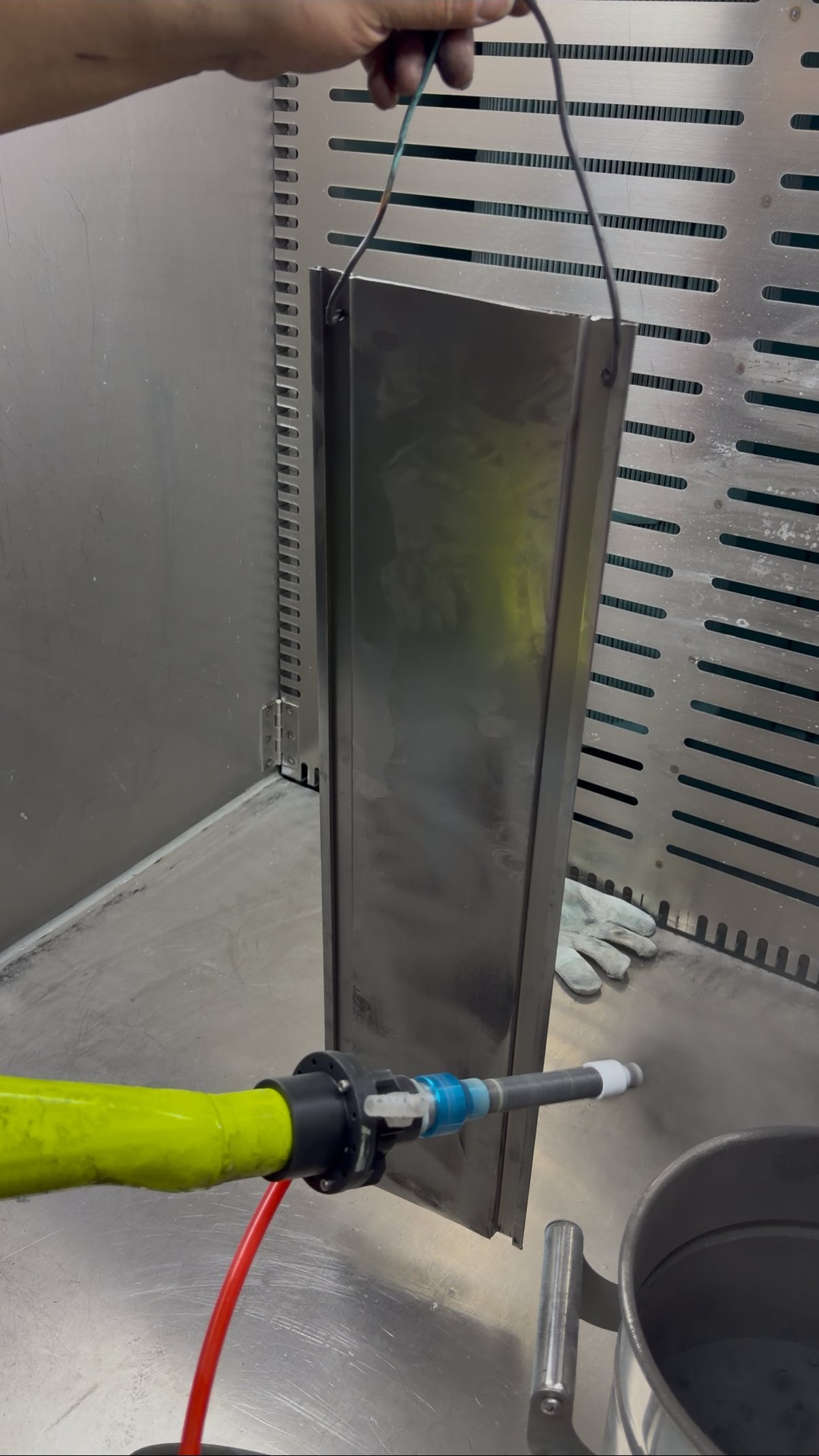
For square tubes, one straight-on pass is rarely enough. Operators usually get better results by changing the spray angle and approaching the tube from multiple directions. This lets powder reach the edge and side face without overloading the front surface.
A practical method is to coat difficult corners first, then finish the broad faces. For example, spray into tube intersections with a lower, more controlled output, then make wider passes along the straight tube runs. This reduces the chance of heavy buildup on easy surfaces while the corner remains thin.
Adjust Voltage, Current, and Powder Flow
High voltage is not always better for square tubes. Strong electrostatic force can pull powder to the first accessible edge or face, making it harder for powder to enter an inside corner. When Faraday cage behavior appears, reducing voltage and current can help the powder cloud move deeper into the recessed area.
Powder flow should also be balanced. Too much powder creates bounce-back and waste. Too little powder may require too many passes and lead to uneven texture. For complex square tube frames, operators often benefit from moderate powder output, stable atomizing air, and a slower pass speed around corners.
Consider Equipment Designed for Complex Geometry
Standard powder guns can coat square tubes, but complex assemblies often need better powder cloud control. A powder coating gun with stable output, adjustable electrostatic settings, and good response at lower power can make a large difference in corners and frame joints.
For QXD / Paint Brothers customers, the Q7 powder coating gun is often considered for parts with deep corners, tube frames, and Faraday cage areas because it allows operators to tune the spray for difficult geometry instead of relying only on high output. The right settings still depend on the part, powder type, grounding, and production speed, so sample spraying is recommended before full production.
Inspection Tips Before Curing
Before sending square tube frames into the oven, check the areas that usually fail first. These include inside corners, welded intersections, bracket edges, underside faces, and the back side of vertical tube runs. A quick visual inspection before curing is cheaper than discovering bare spots after the part is fully cured.
- Look at corners from more than one angle.
- Use good lighting to reveal thin areas.
- Check edges and welds before broad flat surfaces.
- Compare film build on the face, edge, and inner corner.
Practical Process Checklist
- Clean and pretreat the square tube assembly thoroughly.
- Remove sharp burrs, weld spatter, and heavy contamination.
- Confirm grounding through clean hooks and contact points.
- Coat difficult corners and tube intersections first.
- Use controlled voltage and powder flow for recessed areas.
- Change spray angle for each face instead of relying on one pass.
- Inspect edges and inner corners before curing.
Final Thoughts
Powder coating square tubes is not only a question of more powder. The best results usually come from a stable process: clean parts, reliable grounding, smart spray angles, tuned electrostatic settings, and careful inspection before curing. When square tube frames include many welded corners or recessed areas, the right powder coating gun and technique can reduce rework and improve consistency.
If your shop coats square tube frames, carts, racks, railings, or welded metal assemblies, QXD / Paint Brothers can help you review the part geometry and choose a practical powder coating setup. Contact us for a technical consultation, sample spray discussion, or Q7 powder coating gun recommendation.