Corona vs. Tribo Powder Coating Guns: Which Is Right for You?
If you've spent any time researching powder coating equipment, you've run into two terms that come up constantly: corona and tribo. Both are electrostatic charging methods. Both apply dry powder to metal. And both have passionate advocates in the coating industry.
But they work on completely different principles, perform differently on different part geometries, and have very different failure modes. Choosing the wrong one for your production environment doesn't just affect finish quality — it affects powder consumption, rework rates, and the ceiling on what your shop can coat.
This guide breaks down exactly how each technology works, where each one excels, where each one struggles, and what to consider when your parts don't fit neatly into either category.
How Corona Charging Works
Corona guns use a high-voltage electrode — typically a discharge needle at the gun tip — to ionize the air around it. This creates a corona discharge: a cloud of charged ions that attach to powder particles as they pass through the gun's airstream.
The charged particles travel toward the grounded workpiece, drawn by the electrostatic field between the gun and the part. The stronger the voltage, the stronger the field, and in theory, the better the wrap around complex shapes.
Corona is the dominant technology in industrial powder coating worldwide. Most manual guns, automated reciprocators, and booth systems run on corona charging. It works with virtually every powder chemistry and requires no special powder formulation.
The Corona Advantage
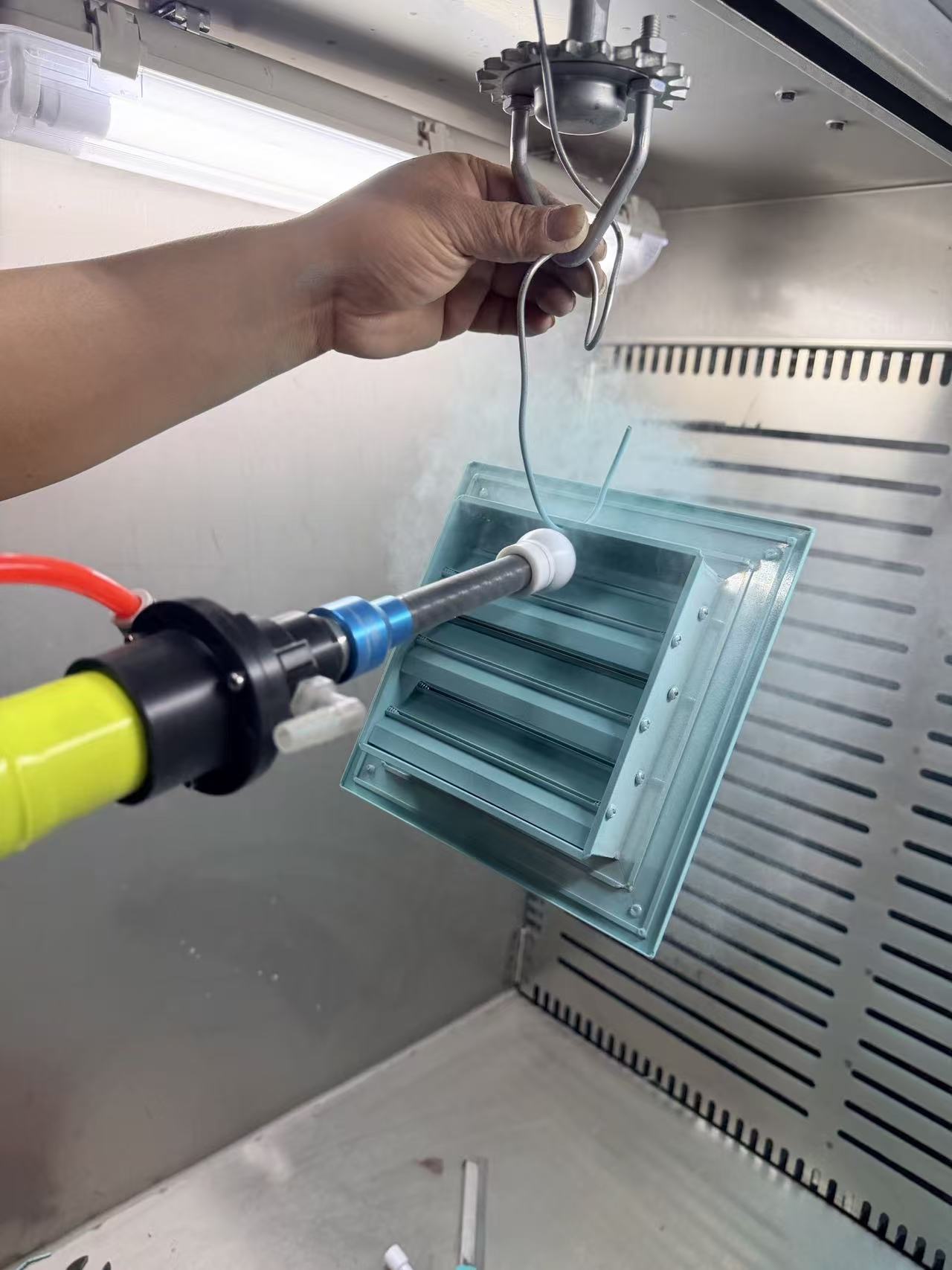
- Works with all standard powder chemistries — polyester, epoxy, hybrid, polyurethane
- Adjustable voltage gives operators control over wrap and coverage
- Well-understood technology with a large base of trained operators
- Lower equipment cost compared to tribo systems
- Fast color changes with proper cleaning procedure
The Corona Limitation
Corona guns are directly responsible for the most common and costly problem in powder coating: the Faraday cage effect. Because corona charging relies on an electrostatic field generated at the gun tip, that field concentrates at edges and external corners — and leaves internal recesses electrostatically shielded.
Powder follows the field. On box sections, channels, welded frames, and internal corners, the field doesn't reach — so the powder doesn't either. The result is bare metal or unacceptably thin film in exactly the areas most vulnerable to corrosion and wear.
Increasing voltage makes this worse, not better. Higher voltage strengthens the field at the edges, which increases the shielding effect on recesses. Operators trying to solve dead zones by cranking up the voltage often produce the opposite result.
How Tribo Charging Works
Tribo guns charge powder through friction rather than through an external electrical field. Powder particles pass through a specifically designed barrel or tube interior — typically made of PTFE or another material with high triboelectric properties — and accumulate charge through contact with the tube wall.
Because no corona discharge is produced at the gun tip, there is no strong external electrostatic field. And without that field, there is no Faraday cage shielding effect. Powder exits the gun with its charge already built in, and it distributes more evenly into recesses that corona guns consistently miss.
The Tribo Advantage
- No Faraday cage effect — powder penetrates internal corners and recessed geometry
- No back ionization — the finish surface quality is generally smoother
- No high-voltage generator required — simpler electrical system
- Better coverage uniformity on complex profiles and extruded sections
The Tribo Limitation
Tribo charging is highly sensitive to powder chemistry. The triboelectric effect depends on the specific interaction between the powder formulation and the charging tube material. Not all powders charge effectively with tribo guns — and some powders won't charge at all.
Powder suppliers must formulate specifically for tribo application, which limits your options and typically increases powder cost. If your shop runs multiple powder suppliers or changes chemistries frequently, tribo guns create compatibility headaches that corona guns simply don't have.
Additionally, the charging tube wears over time and must be replaced on a schedule. Worn tubes produce inconsistent charging and coverage variation that can be difficult to diagnose until reject rates climb.
Corona vs. Tribo: Head-to-Head Comparison
| Factor | Corona | Tribo |
|---|---|---|
| Charging method | External electrostatic field | Friction through charging tube |
| Faraday cage effect | Significant problem | Not a factor |
| Powder compatibility | All standard powders | Tribo-specific formulations only |
| Complex geometry | Struggles on internal recesses | Better penetration |
| Back ionization | Can occur at high voltage | Not a factor |
| Equipment cost | Lower | Higher |
| Operator skill required | Moderate | Higher |
| Color change time | Faster | Slower (tube cleaning required) |
| Wear parts | Needle, deflector | Charging tube |
Which Should You Choose?
The honest answer: neither technology is universally better. The right choice depends on your production mix, part geometry, and powder supply chain.
Choose Corona If:
- Your parts are primarily flat, curved, or simple geometric profiles
- You run multiple powder suppliers or change colors frequently
- Your operators are already trained on corona equipment
- Budget is a primary constraint
- Your production volume justifies automated reciprocating systems
Choose Tribo If:
- Your production is dominated by extruded profiles, channels, or frames with internal geometry
- You run a consistent powder chemistry from a single qualified supplier
- Surface finish quality is the top priority and back ionization is causing orange peel
- You are willing to invest in operator training and more careful maintenance
For shops running mixed production — flat panels one shift, welded box sections the next — neither technology gives you a clean answer. This is where most fabricators end up compromising: running corona on flat work and manually reworking the complex geometry, or paying the powder compatibility premium for tribo on the entire line.
The Third Option: Rotary Centrifugal Atomization

There is a third charging and atomization approach that most buyers overlook because it's newer and less widely discussed: rotary centrifugal atomization.
Instead of an electrostatic field (corona) or friction charging (tribo), rotary guns use a motorized spinning disc — running at approximately 2,000 RPM in the case of the Q7 — to atomize powder through centrifugal force. Because no air blast drives powder toward the part, there is no turbulent pressure pushing powder away from recessed geometry. And because the electrostatic charge is applied to already-atomized particles, the coating penetrates dead zones that corona guns cannot reach.
Unlike tribo, rotary centrifugal atomization is compatible with standard powder chemistries — no special formulation required. Unlike corona, it does not produce the electrostatic field concentration that causes Faraday cage shielding.
The result is a technology that solves the core limitation of both corona and tribo simultaneously: deep penetration into complex geometry, with full powder compatibility. If your shop is losing yield on box sections, welded frames, grooming tables, or any part with internal recesses, this is worth understanding in detail before committing to a gun platform.
For a full breakdown of how atomization technology affects coverage on difficult geometry, see our complete buyer's guide to electrostatic powder coating guns.
Frequently Asked Questions
Can I use a tribo gun with any powder?
No. Tribo guns require powders specifically formulated for triboelectric charging. Standard corona-optimized powders often charge poorly or inconsistently in tribo guns, resulting in uneven coverage and high reject rates. Always confirm tribo compatibility with your powder supplier before switching gun technology.
Does corona or tribo give a smoother finish?
Tribo guns generally produce smoother finishes on simple geometry because they avoid back ionization — the phenomenon where excess charge repels incoming powder and creates surface texture defects. On complex parts, however, the thin or absent film in Faraday cage dead zones is a far larger quality problem than back ionization.
Is tribo better for aluminum extrusions?
For aluminum extrusions with consistent profiles and a single powder chemistry, tribo can outperform corona. The even charge distribution and absence of field concentration give better coverage uniformity on the channels and internal faces of extruded profiles. However, if your extrusion mix includes multiple alloys or surface treatments, powder compatibility must be verified for each.
Why does my corona gun leave thin coating in inside corners?
This is the Faraday cage effect. The electrostatic field generated by the corona discharge concentrates at external edges, leaving internal corners and recesses electrostatically shielded. Powder follows the field — and the field doesn't reach the inside of corners. Increasing voltage typically makes this worse. See our detailed guide on how to powder coat inside corners and recessed areas for operator-level solutions.
Can I run both corona and tribo guns in the same booth?
Yes, technically. Some shops run tribo guns on complex geometry sections of the line and corona guns on flat panels. This requires careful powder management to avoid contamination between tribo-specific and standard powders, and it increases color change complexity. For most job shops, the operational overhead makes a single-technology approach preferable.
How do I know if my reject rate is caused by gun technology vs. operator technique?
Run a controlled test: coat the same part geometry with consistent parameters, then cut and measure film thickness at flat surfaces vs. internal recesses. If flat surfaces are within spec and internal areas are consistently thin or bare, the problem is gun technology — not technique. If coverage is inconsistent across the flat areas as well, operator technique, powder flow settings, or equipment condition is the more likely cause.
Ready to Solve the Geometry Problem Once and For All?
If your production includes parts that neither corona nor tribo handles cleanly — welded box sections, grooming table frames, tool cart bodies, aluminum channel profiles — the Q7's rotary centrifugal atomization was designed specifically for this problem.
Contact the QXD Coating team for full technical specifications, a comparison demonstration, and pricing. Our English-speaking export team responds within 24 hours.
→ Request Q7 Technical Information
Paint Brothers / QXD Coating — Dongguan, China | Worldwide Shipping | English Support