Electrostatic Powder Coating Gun: The Complete Buyer's Guide for Metal Fabricators
You already know powder coating is the finish of choice for metal fabrication — harder than paint, more consistent than liquid spray, and far more durable in the field. What you may not know is that the gun doing the spraying makes more difference than almost any other variable in your line.
The wrong electrostatic powder coating gun wastes powder, leaves coverage gaps on complex parts, and forces your operators to respray jobs that should have been one-pass. The right gun cuts rework, reduces powder consumption, and lets your team coat geometries that previously required masking, repositioning, or hand-finishing.
This guide covers everything a metal fabricator needs to evaluate before purchasing an electrostatic powder coating gun — from how the technology works to the specification differences that matter on the shop floor.
How an Electrostatic Powder Coating Gun Works
An electrostatic powder coating gun applies a high-voltage charge — typically between 30 kV and 100 kV — to dry powder particles as they leave the gun. The workpiece is grounded, creating an electrostatic field that pulls charged particles toward the metal surface and causes them to adhere before the part enters the curing oven.
The principle sounds simple. The execution is where guns diverge significantly.
Atomization: The Core Variable
How a gun breaks powder into particles determines coating consistency, transfer efficiency, and — critically — whether powder reaches recessed areas at all.
Pneumatic Atomization
Compressed air carries powder through the gun and disperses it at the nozzle. This is the standard method used by the majority of powder coating guns on the market. It works well on flat and gently curved surfaces. On internal corners, tubes, and box sections, the airflow creates turbulence that prevents powder from reaching the deepest points — a problem known as the Faraday cage effect.
Rotary Centrifugal Atomization
A motorized spinning disc atomizes powder through centrifugal force rather than airflow. Because no air blast is used to carry particles, there is no turbulent pressure that pushes powder away from recessed geometry. Particles separate uniformly and carry their electrostatic charge into cavities that pneumatic guns consistently miss.
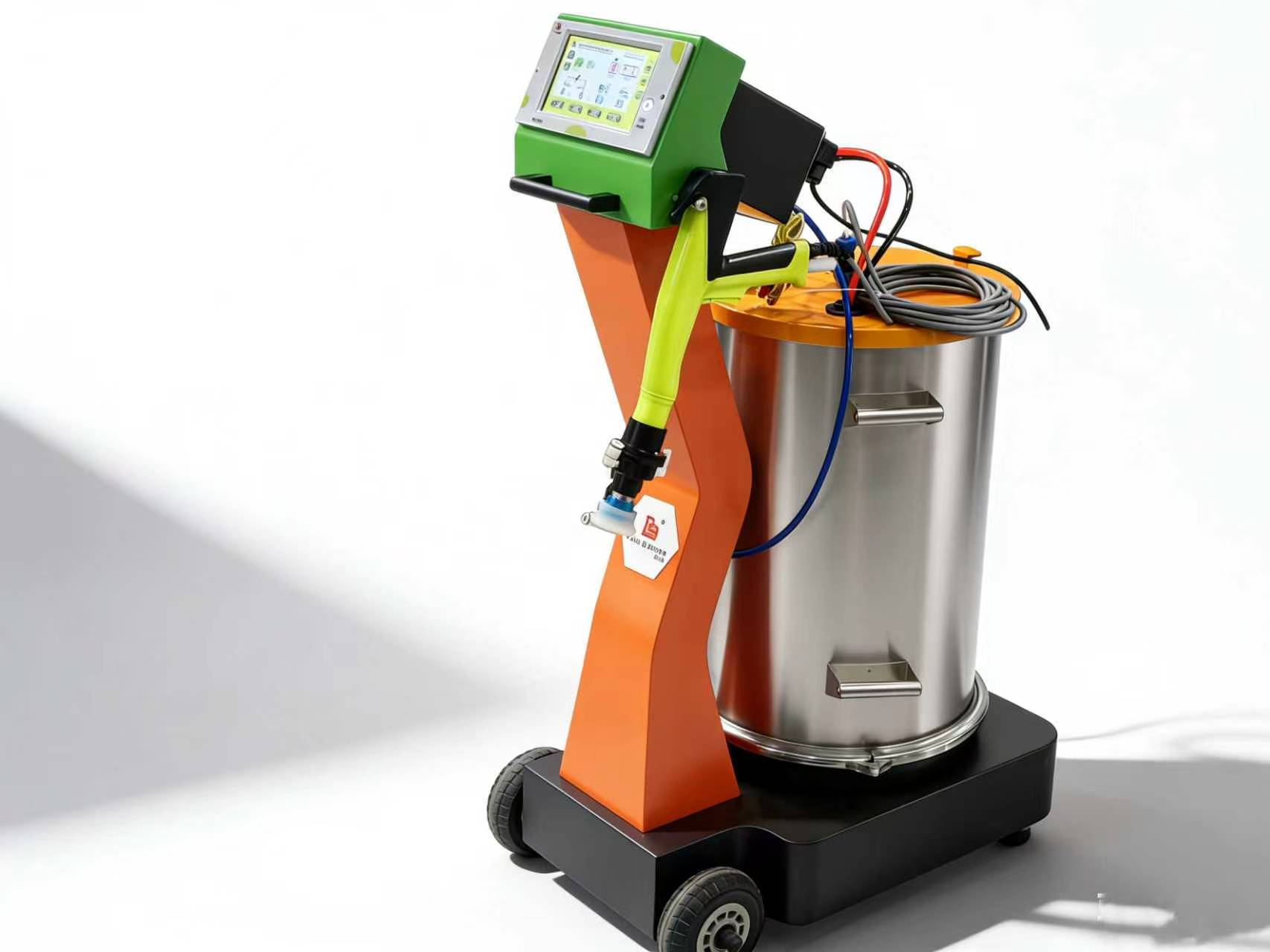
The QXD Q7 uses rotary centrifugal atomization at approximately 2,000 RPM, producing a spiral cross-pattern that penetrates internal corners and structural sections without the air-pressure turbulence that causes Faraday cage dead zones.
The Faraday Cage Problem: Why It Matters for Your Shop
The Faraday cage effect is the single most common cause of coating rejects on complex metal parts. It occurs when electrostatic field lines concentrate at edges and external corners, leaving internal recesses electrostatically shielded. Powder follows the field — and the field does not reach the inside of box sections, welded channels, grooming table legs, and tool cart frames.
The result: bare metal or thin film in exactly the areas most exposed to wear and corrosion in service.
Standard solutions — increasing voltage, moving the gun closer, slowing line speed — partially compensate but do not solve the underlying physics. The only way to reliably coat internal geometry is to change how powder is delivered.
Handheld vs. Fixed Automatic Systems
Before specifying a gun, fabricators need to decide between handheld manual guns and fixed automatic reciprocators.
Handheld Electrostatic Powder Coating Guns
Handheld guns give operators direct control over angle, distance, and dwell time. They are the right choice when:
- Your production includes multiple part geometries or frequent color changes
- Batch sizes are small to medium and SKU variety is high
- Complex geometry — tubes, angles, weldments — requires variable gun positioning
- Capital budget favors lower upfront cost with flexible deployment
Fixed Automatic Systems
Automatic reciprocating guns mounted on a conveyor line deliver consistent results on high-volume, single-geometry production runs. They are the right choice when:
- You are coating one part type at high volume
- Part geometry is flat or uniformly curved
- Labor cost reduction is the primary driver
- Changeover time between colors or parts is acceptable
For most job shops and contract fabricators running mixed production, a high-performance handheld gun is more flexible and cost-effective than a fixed system.
Key Specifications to Evaluate
Output Voltage Range
Most industrial guns operate between 0–100 kV with adjustable output. Higher voltage increases wrap and improves coverage on simple geometry. On complex parts, excessively high voltage worsens the Faraday cage effect. Look for fine-grained voltage adjustment — not just a single preset.
Powder Flow Rate Control
Powder flow should be independently adjustable from voltage. Operators on complex geometry need to reduce flow while maintaining charge — something that single-dial guns do not allow.
Memory Presets
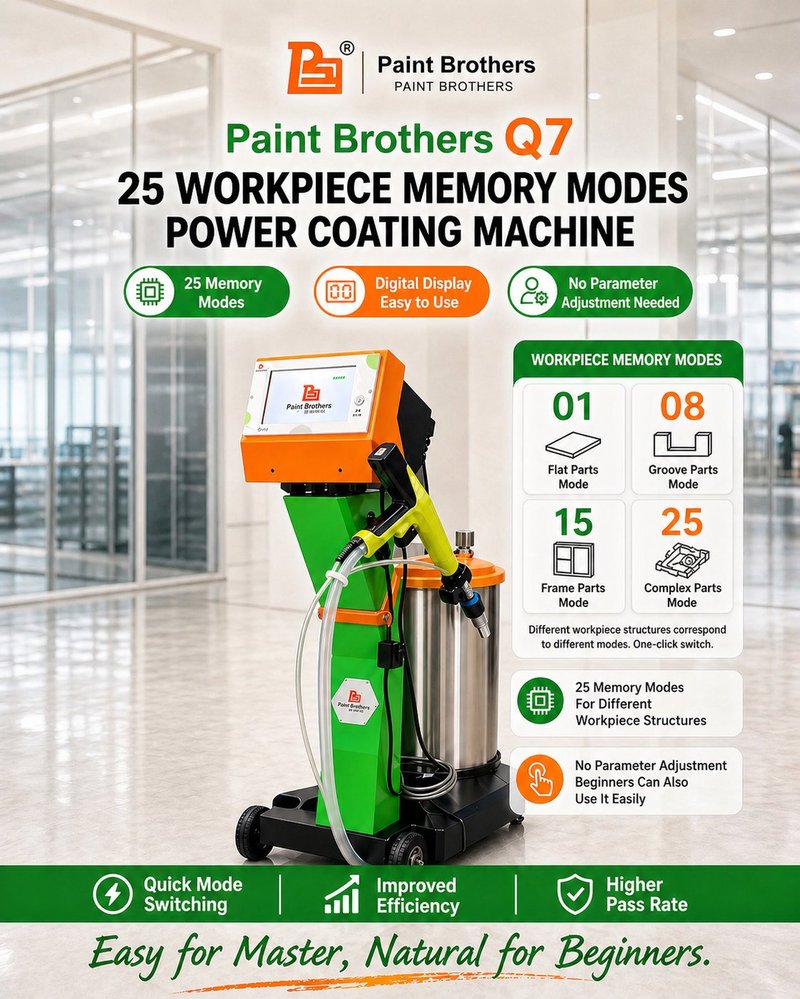
For shops running multiple part types, the ability to save parameter sets — voltage, flow, atomization speed — eliminates per-job setup time and reduces operator-to-operator variation. The Q7 supports 25 workpiece memory presets, switchable at the trigger between flat-surface and dead-zone modes.
Wear Parts and Serviceability
On pneumatic guns, the discharge needle, duck-bill, and deflector are wear items that require regular replacement. Rotary atomization guns have fewer contact wear parts because powder dispersal is mechanical rather than impact-based. Evaluate parts availability and cost before committing to any platform.
Total Cost of Ownership: Beyond the Purchase Price
Powder Transfer Efficiency
Transfer efficiency — the percentage of sprayed powder that adheres to the part — directly determines powder consumption per part. A gun with 70% transfer efficiency uses 43% more powder per square meter than one operating at 90%. On powder costs of $3–6 per kg, that difference compounds quickly across a full production shift.
Rework Rate
Every part pulled off the line for respray costs labor, oven time, and powder. If your current gun produces consistent Faraday cage rejects on complex parts, the true cost includes all downstream rework — not just the gun itself.
Maintenance and Downtime
Guns that require frequent needle or nozzle changes, or that are sensitive to powder clumping in humid environments, create unplanned downtime. Ask manufacturers for maintenance interval data before purchasing.
Frequently Asked Questions
What voltage should I use for powder coating?
For flat and gently curved surfaces, 60–80 kV typically produces good wrap and even coverage. For internal corners and recessed geometry, reducing voltage to 30–50 kV while using rotary atomization technology improves penetration by reducing the electrostatic repulsion that drives the Faraday cage effect.
Can one gun handle both flat surfaces and complex geometry?
Standard pneumatic guns struggle on both simultaneously. The Q7 addresses this with a dual-mode trigger system — one mode optimized for flat surfaces, one for dead-zone penetration — switchable mid-job without stopping the line.
How often do powder coating gun parts need to be replaced?
On pneumatic guns, discharge needles typically require replacement every 200–400 operating hours depending on powder type and throughput. Rotary atomization systems have fewer direct-contact wear components. Establish a baseline for your specific production volume and track replacement intervals from the first installation.
What powder flow rate is normal for a handheld gun?
Most industrial handheld guns operate between 100–400 grams per minute depending on part size and geometry. Complex parts with tight sections benefit from lower flow rates (100–200 g/min) paired with slower pass speed to allow powder to settle before the electrostatic field dissipates.
Is compressed air required for electrostatic powder coating guns?
Pneumatic guns require a clean, dry compressed air supply — typically 4–6 bar — to fluidize and carry powder. Rotary centrifugal atomization guns like the Q7 use a motorized disc for powder dispersal and require significantly less air, reducing operating cost and eliminating the turbulence that causes Faraday cage dead zones.
What powder types are compatible with the Q7?
The Q7 is compatible with standard thermosetting powder coatings including polyester, epoxy-polyester hybrid, pure epoxy, and polyurethane chemistries. No proprietary powder is required.
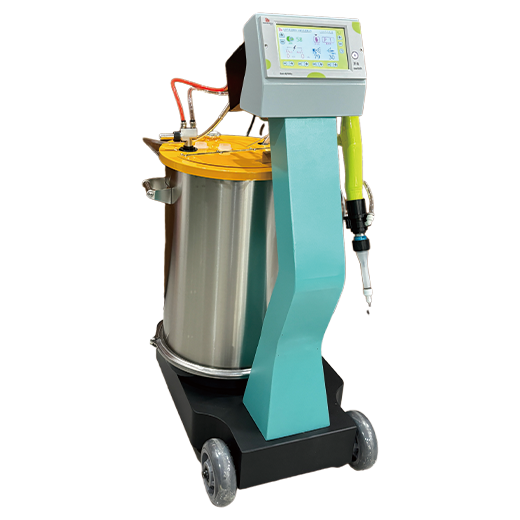
Ready to Coat the Parts Your Current Gun Cannot Handle?
If your shop is dealing with rejects on complex geometry, running multi-pass workflows on inside corners, or leaving touch-up work for operators at the end of the line — the problem is not your operators. It is the atomization technology in your gun.
Contact the QXD Coating team for Q7 specifications, pricing, and a video demonstration on parts similar to yours. Our English-speaking export team responds within 24 hours.
→ Request Q7 Technical Information
Paint Brothers / QXD Coating — Dongguan, China | Worldwide Shipping | English Support