
Rotary Cup Nozzle Selection: Which Nozzle for Which Part?
Most coating problems blamed on the gun are actually nozzle problems. A shop buys a rotary cup system, runs everything through one nozzle, and then wonders why panels look perfect while grooved parts come out thin.
The rotary cup itself sets the atomization quality. The nozzle decides where that powder can reach. This guide explains how to match the four standard nozzles to your parts — and, just as importantly, when each one is the wrong choice.
Why Nozzle Diameter Changes Your Result
Nozzle diameter controls the trade-off every coating shop lives with:
- Larger diameter → wider spray pattern, faster coverage on open surfaces, but poor access into narrow spaces.
- Smaller diameter → tighter, more focused delivery that reaches into grooves and recesses, but slower on large areas.
There is no nozzle that wins on both. Shops that understand this stop looking for one perfect nozzle and start matching nozzles to part families.
The Four Nozzles at a Glance
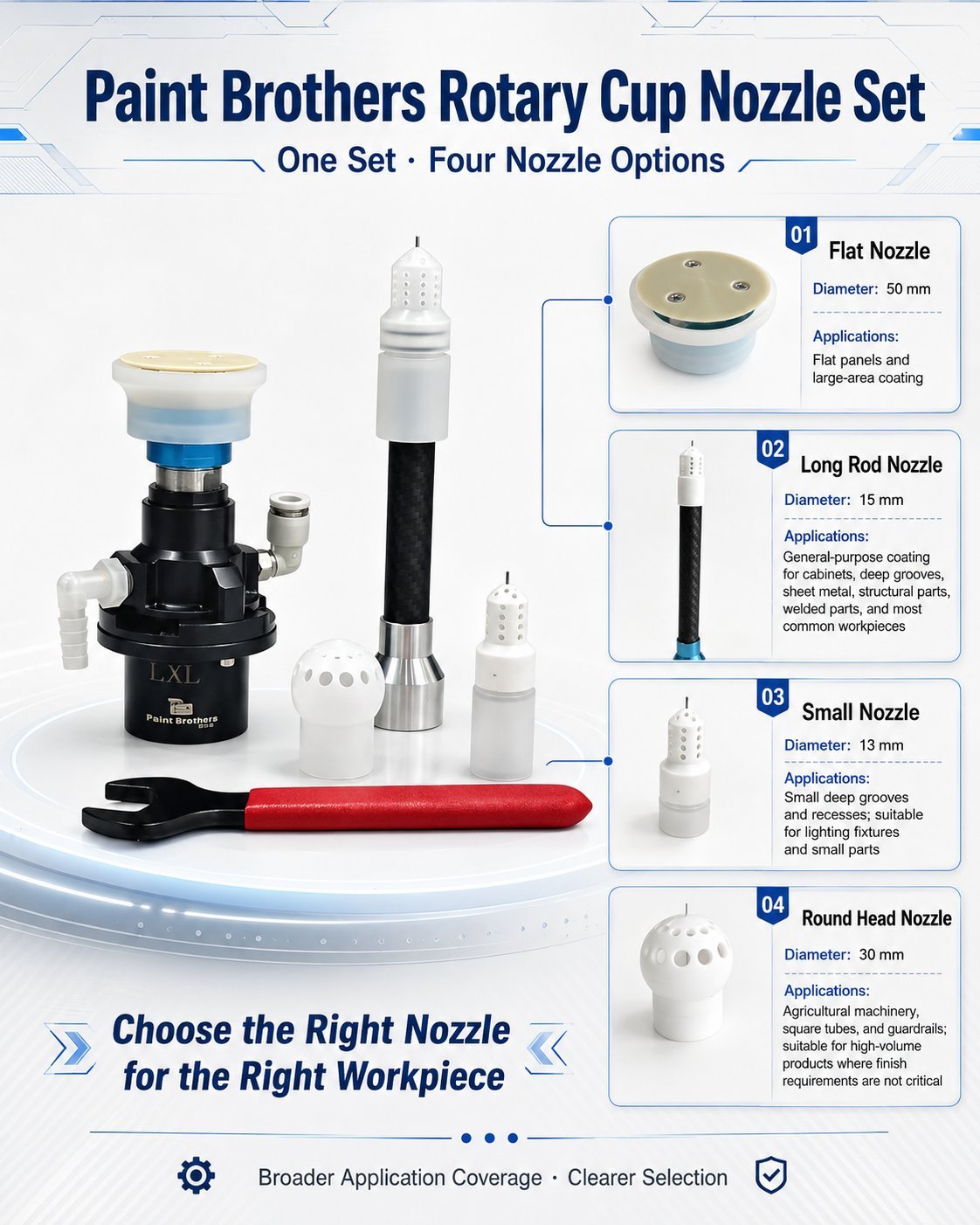
| Nozzle | Diameter | Best For | Avoid When |
|---|---|---|---|
| Flat Nozzle | 50 mm | Flat panels, doors, broad sheet-metal faces | Narrow grooves or deep recesses |
| Long Rod Nozzle | 15 mm | Cabinets, deeper grooves, structural and welded parts | Groove clearance not yet verified |
| Small Nozzle | 13 mm | Small deep grooves, recesses, small parts, lighting fixtures | Large-area production work |
| Round Head Nozzle | 30 mm | Square tube, guardrail, fence posts, agricultural machinery | Very high appearance requirements |
Flat Nozzle (50 mm) — Large Open Surfaces
The widest pattern of the four. Built for throughput on open surfaces where the measure of success is film uniformity across a broad face.
Typical parts: panels, door skins, broad surfaces, sheet-metal faces.
Choose it when your work is dominated by flat area and you are judged on even film thickness and powder-laying efficiency.
Do not choose it when the part has narrow grooves or deep recesses. The wide pattern simply cannot deliver powder into confined geometry — this is not a setting you can tune around.
Long Rod Nozzle (15 mm) — The Safe Default
If you are unsure where to start, start here. The Long Rod is the general-purpose nozzle: narrow enough to reach into structures, still productive on ordinary surfaces.
Typical parts: cabinets, deeper grooves, sheet metal, structural parts, welded assemblies.
Choose it when you run mixed work, or when parts require reach into a groove or cabinet structure.
Before committing, confirm three dimensions: groove width, groove depth, and working clearance. "It should fit" is not a specification — measure it.
Small Nozzle (13 mm) — Confined Geometry
The most focused delivery of the four. This is the nozzle for the areas other nozzles cannot service.
Typical parts: small stamped parts, die-cast parts, small grooves, small recessed areas, lighting components.
Choose it when the target area is small, narrow, or needs concentrated access.
Do not choose it as a large-area production nozzle. Using a Small Nozzle to cover broad surfaces will cost you cycle time on every part — it is a precision tool, not a productivity tool.
Round Head Nozzle (30 mm) — Volume Structural Work
Built for repetitive structural parts where coverage and throughput matter more than a show-grade finish.
Typical parts: agricultural machinery, square tube, guardrail, fence posts, and similar structural products.
Choose it when you are running high volumes of repeated structural parts and productivity drives your cost per piece.
Verify first if appearance standards are demanding. Run a test spray before committing a production line to this nozzle.
How to Choose: A Decision Path
- Start with geometry, not the spec sheet. Photograph the part. Measure groove width and depth.
- Broad open surface? → Flat Nozzle
- Cabinet, groove, or general structural part? → Long Rod Nozzle
- Small groove, recess, or lighting part? → Small Nozzle
- Guardrail, square tube, agricultural machinery, high volume? → Round Head Nozzle
What If One Part Has Both Flat Areas and Deep Grooves?
This is the most common real-world case, and it deserves a straight answer: no single nozzle handles both well.
Shops solve this two ways:
- Split the process — coat recessed areas with a narrower nozzle, then cover open faces with a wider one.
- Split the parts — group your work into part families and assign a nozzle to each family rather than switching constantly.
Any supplier who tells you one nozzle covers every geometry is selling, not engineering.
Frequently Asked Questions
Which rotary cup nozzle should I buy first?
The Long Rod Nozzle (15 mm) is the most versatile starting point. It handles cabinets, grooves, sheet metal and structural parts, which covers the majority of general fabrication work.
My part has a 10 mm wide, 80 mm deep groove. Can a rotary cup coat it?
Deep narrow grooves are exactly where rotary cup atomization has an advantage over conventional guns, but a ratio like this is near the limit of what any nozzle can service reliably. Do not decide from a catalogue — send the part dimensions or a sample for a test spray. Groove width, depth, opening angle and grounding all affect the outcome together.
Can I change nozzles on the same gun?
Yes. Nozzles are matched to part geometry, so shops running mixed work typically keep more than one on hand and change according to the job.
Will a smaller nozzle always give better groove coverage?
Better access, yes — but at the cost of productivity on open areas. Choose the smallest nozzle that reaches your critical geometry, not the smallest nozzle available.
Does the nozzle alone determine coating quality?
No. Nozzle choice determines where powder can reach. Final quality also depends on workpiece geometry, grounding, powder quality, powder delivery, booth airflow, spray distance, line speed, curing, and operator process control. If coverage is poor, check grounding before changing nozzles — it is the most frequently overlooked cause.
An Honest Note on Expectations
Rotary cup equipment is not a universal fix for every coating defect. It solves atomization and transfer efficiency problems very well. It does not compensate for poor grounding, contaminated powder, incorrect curing, or an unstable line.
Before making a final equipment decision, use test spraying or on-site data from your own parts. Any conclusion drawn without touching your actual workpieces is a guess.
Not Sure Which Nozzle Fits Your Parts?
Send us photographs and dimensions of your workpiece — particularly groove width and depth — and we will tell you which nozzle configuration suits your application, including cases where a rotary cup is not the right answer.
We can also arrange a test spray on your own parts before you commit to equipment.
- Email: jerry@qxdcoating.com
- WhatsApp: +1 646 371 8844
- Products: Rotary Cup Powder Coating Equipment