
Powder Coating Wire Mesh, Grating, and Fence How to Get Full Coverage Without Blowback
Wire mesh, expanded metal grating, and chain-link fence present a coating challenge that flat sheet and tube fabricators rarely encounter: the powder has nowhere to land.
On solid surfaces, electrostatic attraction pulls charged powder particles toward the grounded metal and holds them there until the part enters the oven. On open mesh, the same electrostatic field wraps around the wires — but a significant portion of the powder that should be landing on the metal passes straight through the gaps and ends up on the booth floor or the recovery system.
This problem has a name: blowback. And for fabricators running wire products, it's the single biggest driver of high powder consumption, uneven film thickness, and rejected parts.
This guide covers why blowback happens, why standard approaches to fixing it usually make things worse, and what changes at the gun level produce consistent, measurable improvement on open mesh geometry.
Why Wire Mesh Is Different From Every Other Metal Part
Most powder coating troubleshooting assumes a solid substrate. The Faraday cage effect, back ionization, orange peel, thin film on inside corners — all of these problems occur on parts where the metal surface is continuous. Wire mesh introduces a completely different set of physics.
When a corona gun sprays charged powder at a solid part, the electrostatic field terminates at the metal surface and the powder sticks. When the same gun sprays at wire mesh, the field passes through the gaps as well as terminating at the wires. Powder carried by the airstream through those gaps doesn't reverse course — it continues through and is lost.
The result is a coating that is heaviest at the wire crossings, thinner along the wire spans, and absent entirely on the back face of the mesh in many cases. Cut sections and film thickness measurements across a mesh panel coated with a standard corona gun routinely show variation of 40–80% between the front face wire crossings and the rear wire faces.
The Blowback Problem: Why More Air Makes Things Worse
The instinctive response to thin coverage on mesh is to increase powder flow and spray pressure. More powder in the air means more powder landing on the part — in theory.
In practice, increasing airflow on open mesh geometry makes blowback significantly worse. The higher the air velocity from the gun, the more powder passes through the gaps rather than wrapping around the wire surfaces. You end up with thicker buildup at the wire crossings (which can cause runs and texture defects after curing), no improvement on the rear wire faces, and dramatically higher powder consumption per part.
The same problem occurs when operators move the gun closer to the mesh to increase transfer efficiency. Close-range spraying with a corona gun increases the electrostatic field strength at the front face but does nothing to improve wrap around the back of the wire — and the higher air velocity at close range drives more powder through the gaps.
How the Faraday Cage Effect Compounds the Problem
Wire mesh doesn't just suffer from blowback. On mesh with tight apertures — window screen, industrial filtration mesh, decorative perforated panels — the Faraday cage effect compounds the coverage problem significantly.
The electrostatic field from a corona gun concentrates at the outermost wire surfaces — the sharp edges of wire crossings and the front face of the mesh. The interior of the mesh apertures, and the rear wire surfaces, are partially shielded from the field. Powder follows the field — so the shielded areas receive less powder even when blowback isn't a factor.
On tight mesh, this creates a predictable failure pattern: heavy coating on the front-face wire crossings, light coating on the wire spans, and near-zero coating on rear wire surfaces. This is exactly the pattern that leads to corrosion failures on wire products in outdoor or corrosive service environments — the uncoated or thin-coated rear surfaces are the first to rust.
Gun Technique Adjustments That Actually Help
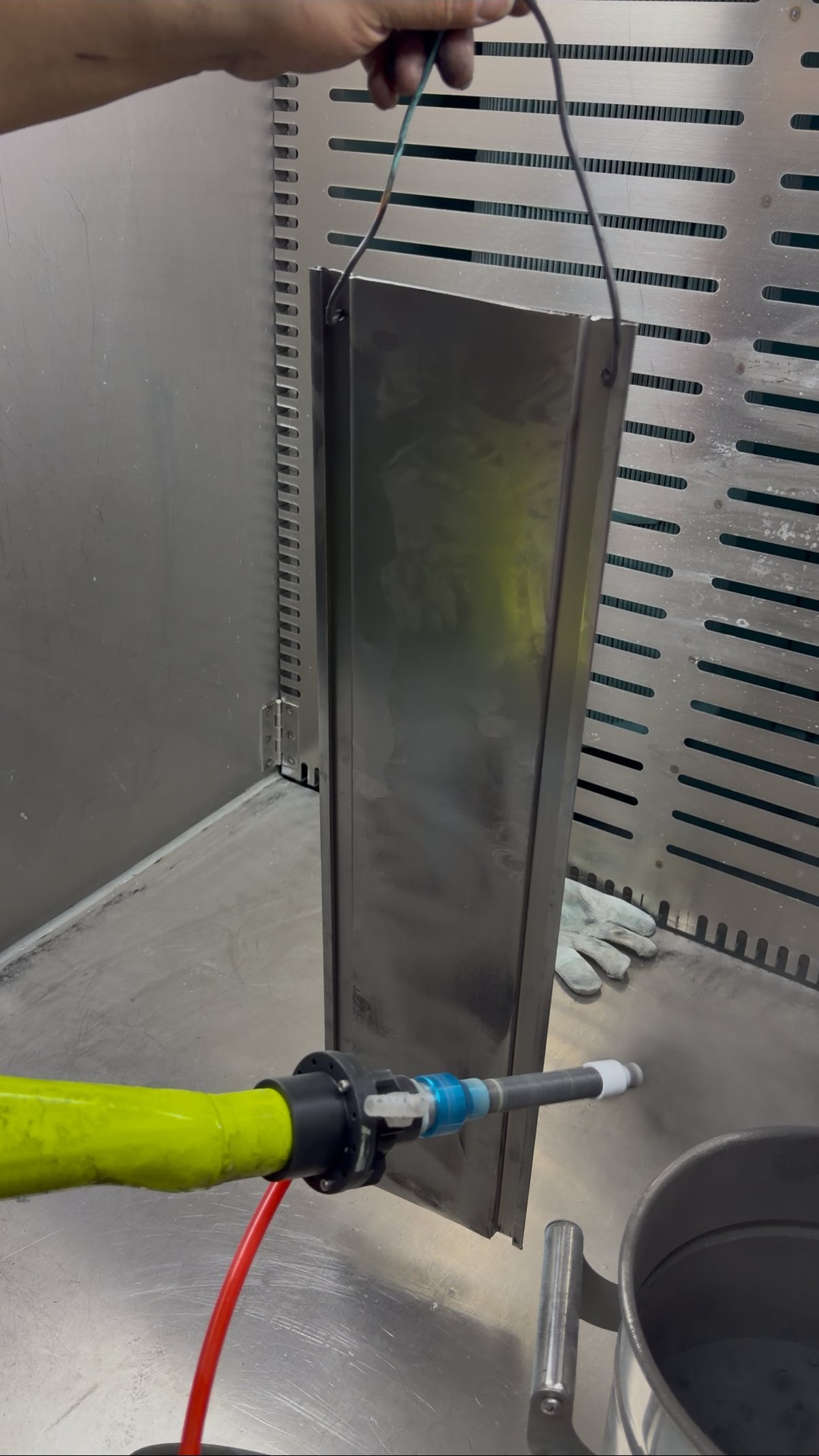
Before changing equipment, there are technique adjustments that produce measurable improvement on mesh and open geometry.
Reduce Air Pressure, Not Increase It
Counterintuitively, reducing powder flow rate and gun air pressure improves transfer efficiency on mesh. Lower air velocity means less powder passes through the gaps and more wraps around the wire surfaces. The tradeoff is slower deposition — operators need to slow their pass speed to compensate — but the powder that does land stays on the part instead of passing through.
Increase Distance and Reduce Voltage
Spraying from a greater distance (40–60 cm rather than 20–30 cm) reduces the electrostatic field concentration at the front wire surfaces and allows more wrap around the rear. Reducing voltage has a similar effect: a weaker field concentrates less at the nearest surfaces and produces more even distribution across the wire geometry.
Angle the Gun
Spraying at a 30–45 degree angle to the mesh plane rather than perpendicular gives powder a geometric path to reach the rear wire surfaces. This is particularly effective on open mesh and grating where the rear surfaces are directly accessible from an angled approach.
For a full guide to technique adjustments on difficult geometry, see our article on how to powder coat inside corners and recessed areas.
Why Rotary Atomization Outperforms Corona on Mesh
Technique adjustments improve results on mesh but don't solve the underlying physics problem. The fundamental issue is that corona guns use compressed air to carry powder — and that airstream is what drives blowback through the mesh apertures.
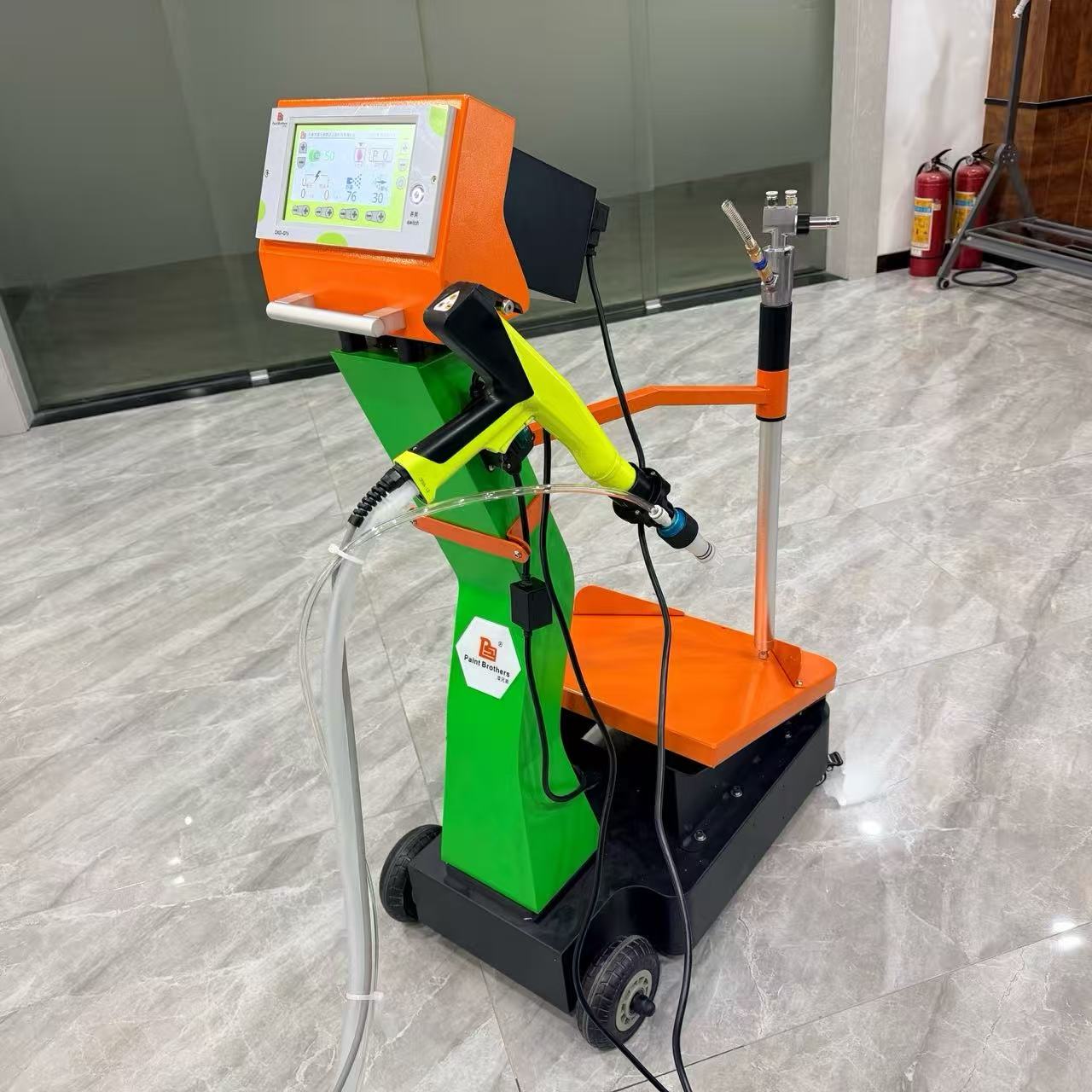
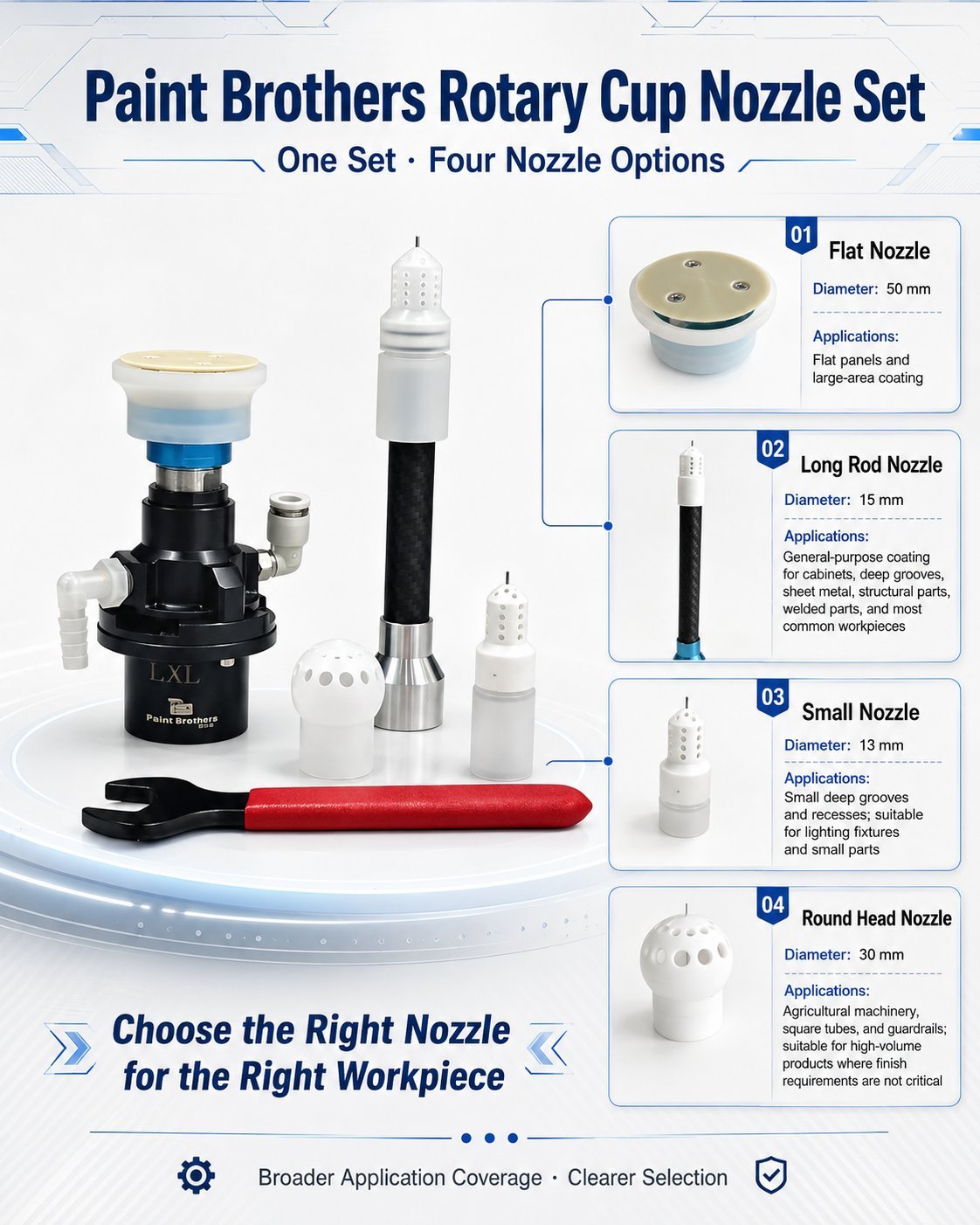
Rotary centrifugal atomization eliminates the airstream entirely. Instead of compressed air carrying powder from the gun to the part, a motorized spinning disc — operating at approximately 2,000 RPM in the Q7 — breaks powder into fine particles through centrifugal force. The particles leave the disc with their electrostatic charge already applied and travel toward the grounded workpiece without an air carrier.
Without an air carrier, there is no pressure driving powder through the mesh gaps. Particles that reach the mesh surface wrap around the wire geometry under electrostatic attraction rather than being driven through by airflow. The result is dramatically improved rear-face coverage and significantly reduced powder loss through the apertures.
On wire mesh and open grating, rotary atomization typically produces rear-face film thickness that is 60–80% of front-face film thickness — compared to 10–30% rear-face coverage with standard corona guns using equivalent process parameters.
Application-Specific Considerations
Chain-Link and Welded Wire Fence
Chain-link fence presents the additional challenge of diamond-shaped apertures at multiple angles to the spray direction. No single gun angle covers all wire surfaces optimally. For chain-link, rotary atomization's wrap-around capability reduces the number of passes required to achieve full coverage, and the lower air velocity means powder doesn't accumulate unevenly at wire intersections.
Industrial Grating and Flooring
Bar grating and safety grating have deep sections and rear faces that are essentially invisible from the front. Standard corona guns produce thin or absent coating on the rear and underside of grating bars. Rotary atomization significantly improves penetration into these areas, though parts with very deep sections may still require a dedicated rear pass.
Decorative Perforated and Expanded Metal
Decorative panels with tight aperture patterns — used in architectural cladding, furniture, and retail fixtures — are particularly sensitive to coating uniformity because finish appearance is the primary requirement. Blowback on these parts creates visible uneven sheen and color variation. Lower air pressure, angled gun technique, and rotary atomization each contribute to more uniform film distribution across the panel surface.
Frequently Asked Questions
Why does my mesh have heavy powder at the wire crossings but bare spots elsewhere?
This is the combination of Faraday cage shielding and electrostatic field concentration. The wire crossings are the nearest points to the gun and receive the strongest field — so they accumulate the most powder. The wire spans and rear surfaces are partially shielded and receive significantly less. Reducing voltage and increasing spray distance improves distribution. Rotary atomization eliminates the airstream component that drives uneven deposition.
How much powder am I losing through the mesh gaps?
On open mesh with a standard corona gun at typical process settings, powder loss through gaps commonly runs 30–50% of total powder sprayed. On tighter mesh the percentage is lower but film uniformity problems are more severe. Reducing air pressure and using rotary atomization are the two most effective ways to reduce this loss.
Should I coat mesh parts horizontally or vertically?
Vertical hanging is standard for most mesh products. Horizontal jigging can help on very open mesh where powder needs to settle onto rear surfaces under gravity, but it complicates line flow and increases handling. Technique and equipment changes at the gun are more practical than jigging orientation changes for most production environments.
Does preheating the part help with mesh coverage?
Preheating improves powder adhesion on solid parts by warming the substrate and improving electrostatic attraction. On open mesh, preheating has limited effect on the blowback and shielding problems — the physics of powder passing through gaps is not temperature-dependent. Focus technique and equipment improvements on the gun side rather than substrate preparation for mesh-specific coverage problems.
What film thickness should I target on wire mesh?
Target front-face film thickness of 60–80 microns for most exterior wire applications. Rear-face film thickness will be lower — the goal is a minimum of 40 microns on rear surfaces for adequate corrosion protection. If rear-face measurements consistently fall below 30 microns, gun technique or equipment changes are needed before the coating will meet service life requirements.
Can I powder coat very fine wire mesh, like window screen?
Fine wire mesh with apertures under 2mm is extremely difficult to powder coat with consistent results. The mesh acts as a nearly complete Faraday shield, and blowback losses are very high. For fine mesh applications, electrostatic liquid spray or dip coating typically produces more consistent results than dry powder. If powder coating is required, consult the gun manufacturer for application-specific process parameters.

Getting Consistent Results on Your Wire and Mesh Products
Wire mesh, grating, and fence products don't have to be the most wasteful parts in your coating operation. The combination of reduced air pressure, correct gun distance, angled spray technique, and rotary centrifugal atomization technology produces measurably better coverage uniformity and lower powder consumption than standard corona guns at typical settings.
If you coat wire products regularly and want to see how the Q7's rotary atomization performs on your specific mesh geometry, contact the QXD Coating team. We can provide process parameters and video demonstration on mesh products similar to yours.
→
→ Request Q7 Information for Wire and Mesh Applications
Paint Brothers / QXD Coating — Dongguan, China | Worldwide Shipping | English Support