
How to Improve Powder Coating on Corners and Edges
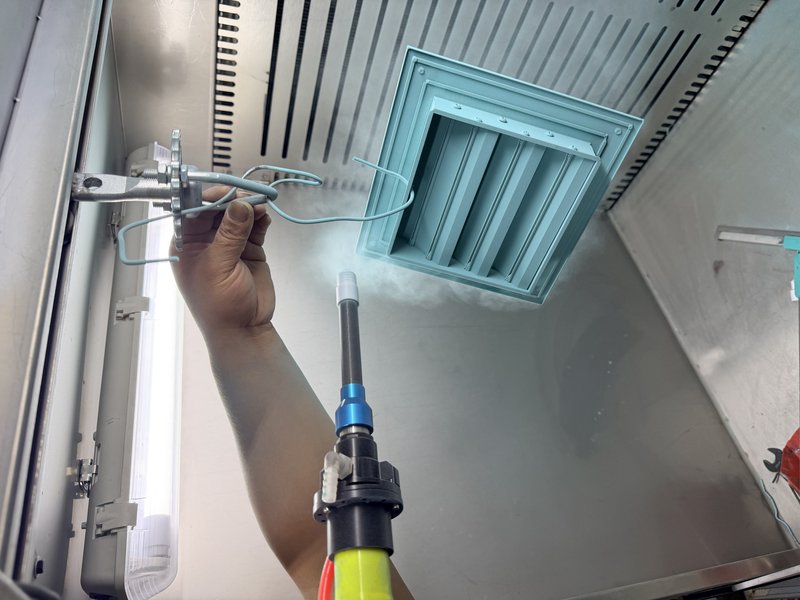
Powder coating corners and edges is one of the most persistent challenges in finishing operations. Whether you're coating metal brackets, welded frames, or complex structural components, these areas consistently show uneven coverage, thin spots, or complete misses — even when flat surfaces look perfect.
This guide breaks down why corners and edges are so difficult to coat, and what you can actually do about it.
Why Corners and Edges Are Hard to Coat
The core problem is physics. When a charged powder particle travels toward a grounded workpiece, it follows the path of least resistance in the electrostatic field. Flat surfaces attract powder evenly. But at corners and edges, the electric field lines concentrate and then wrap around — creating zones where powder either builds up excessively on the edge tip, or fails to penetrate into the recessed corner at all.
This is the foundation of what's known as the Faraday cage effect: enclosed or recessed areas block electrostatic field penetration, leaving powder unable to reach the surface. Corners act as miniature Faraday cages. The deeper or tighter the corner, the worse the problem becomes.
Common Problems You'll See
- Thin coverage on inner corners: The electrostatic field can't reach deep enough, so powder density drops sharply just a few millimeters in from the edge.
- Over-coating on outer edges: The field concentrates at sharp protruding edges, pulling excess powder and causing runs, orange peel texture, or powder falloff during curing.
- Inconsistent film thickness: Even if the corner looks coated visually before curing, the film build may be far below spec, leading to corrosion failures later.
- Rework and reject rates: Corners are usually the first place quality inspectors check — and the first place parts fail.
Technique Adjustments That Help
Before looking at equipment, there are several operator technique adjustments that can reduce corner coating problems:
Adjust your gun angle. Instead of spraying directly at the workpiece from the front, angle the gun at 30–45 degrees to direct powder into corners rather than across them. This forces more particles to follow the contour of the surface into recessed areas.
Reduce voltage for tight corners. Lower electrostatic voltage reduces the field intensity that repels powder from deep recesses. Many operators run 60–80 kV for flat surfaces but drop to 30–50 kV when working on complex geometry. The tradeoff is reduced transfer efficiency on open areas, so adjust as needed.
Increase powder flow slightly. More powder volume helps compensate for the reduced deposition efficiency in difficult areas. Use short, deliberate strokes rather than long sweeping passes.
Move slower near corners. Dwell time matters. Slowing your gun speed near corners gives powder more time to settle into recessed areas before you move on.
Apply a second pass from a different angle. For critical components, a two-pass approach — first pass at standard angle, second pass angled into corners — significantly improves coverage consistency.
Where Conventional Guns Hit Their Limits
These technique adjustments help, but they don't solve the underlying physics. A conventional pneumatic powder gun works by pushing charged powder particles toward the workpiece using airflow. The problem is that airflow creates turbulence in corners and recesses, blowing powder back out just as it starts to deposit.
The result: no matter how skilled the operator, there are corners that conventional guns simply cannot coat reliably. This is especially true for:
- Square and rectangular hollow tubing (common in furniture, shelving, and tool carts)
- HVAC components with deep channels and bends
- Welded assemblies with internal angles
- Any component where the coating must reach a surface that "faces away" from the gun
Rotary Atomization: A Different Approach to Corner Coating
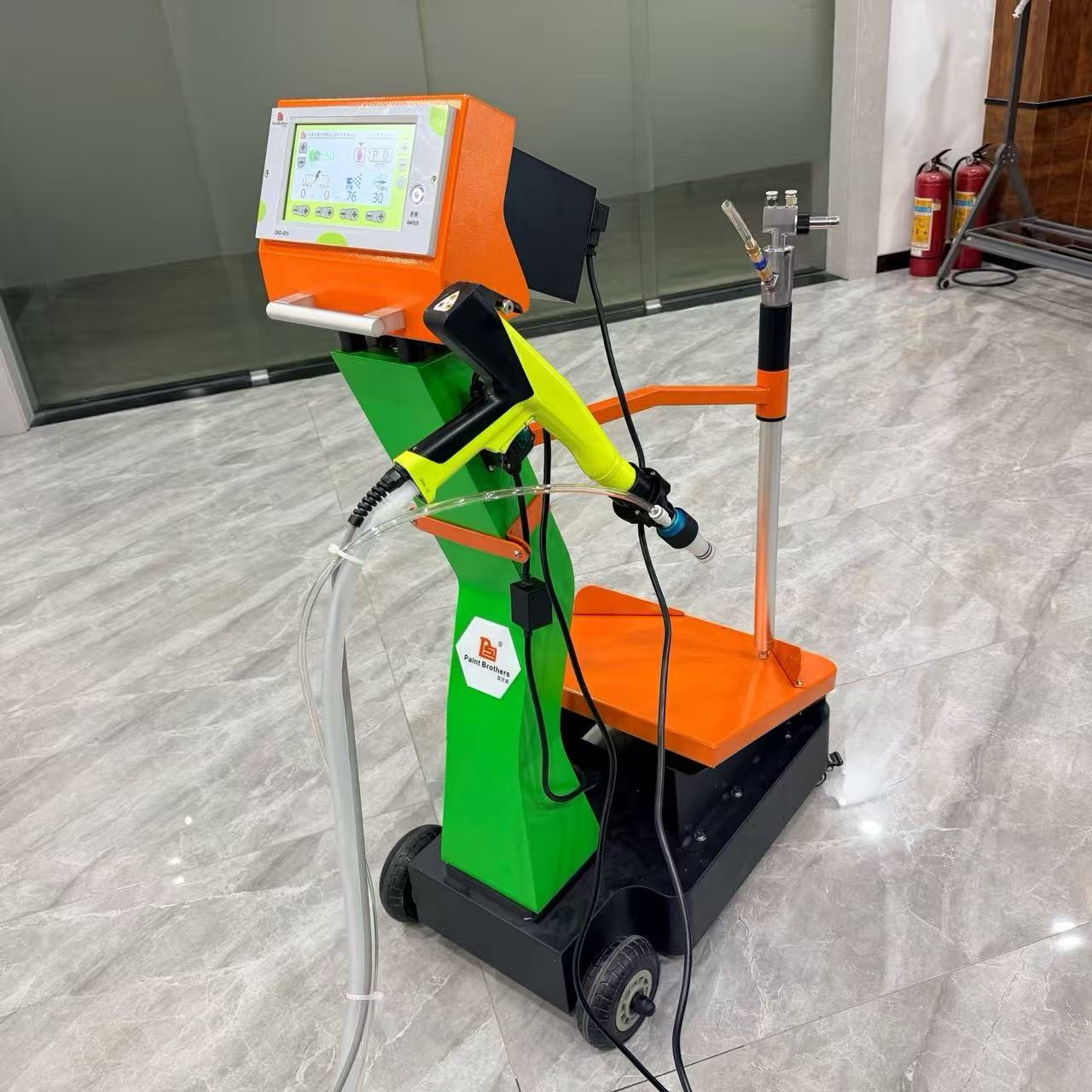
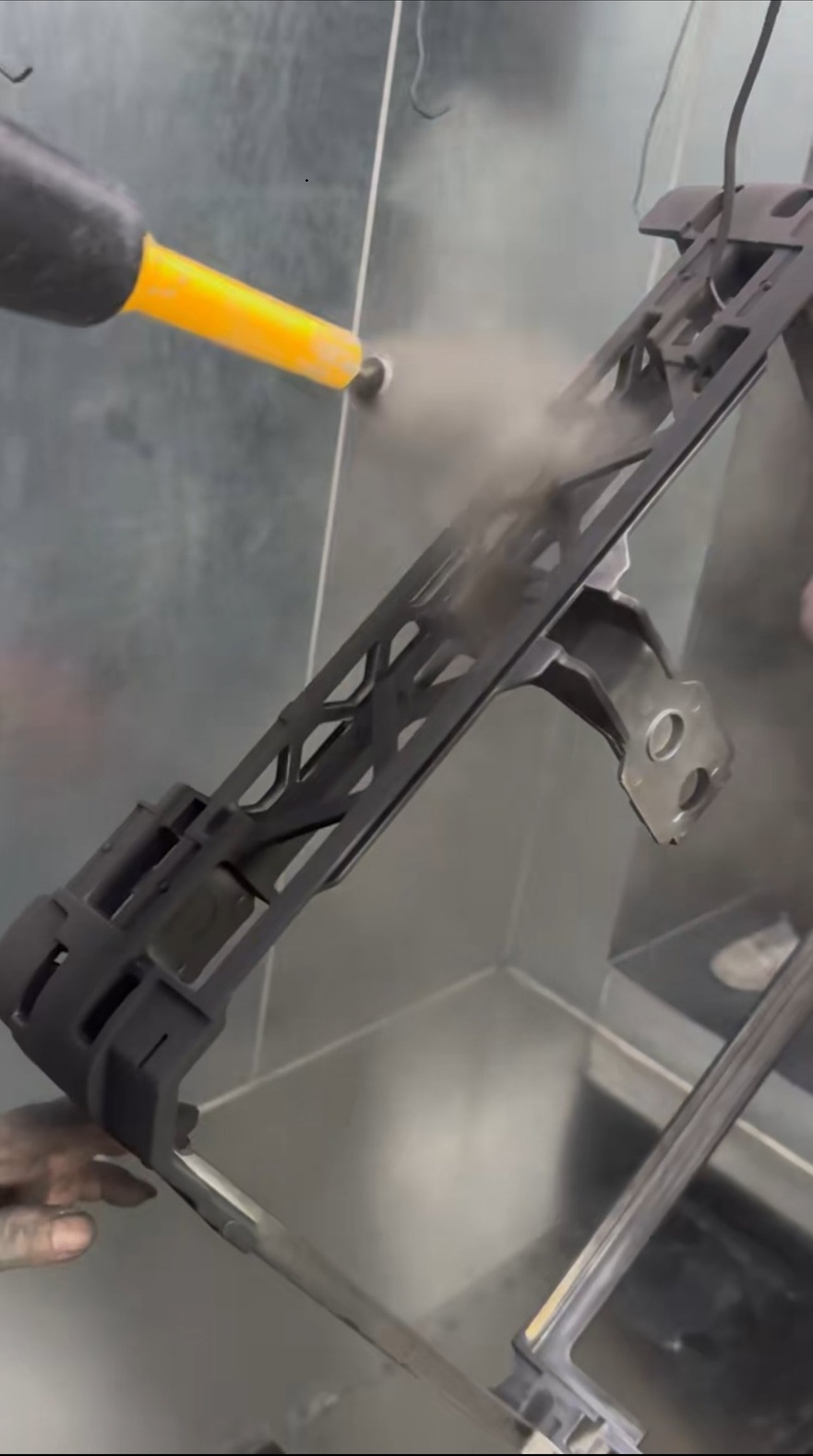
The fundamental limitation of conventional guns is that they rely on airflow to carry powder. Rotary atomization eliminates this dependency entirely.
A rotary atomization powder coating gun uses centrifugal force — not air pressure — to break powder into fine, evenly distributed particles. The rotating cup spins at high speed, and powder particles leave the cup edge with consistent size, charge, and velocity. Because there's no turbulent airflow, particles can follow electrostatic field lines into corners and recesses without being blown back out.
This is why rotary atomization technology represents a meaningful advance for coating complex geometry. For workpieces where the Faraday cage effect has been an ongoing problem, the difference in corner coverage quality is immediately visible.
To understand more about how rotary atomization specifically addresses the Faraday cage effect in recessed areas, see our detailed technical article: How a Rotary Powder Coating Head Helps Improve Coating in Faraday Cage Areas
Practical Checklist for Better Corner Coverage
Before your next run on complex workpieces, verify the following:
- Gun angle adjusted to direct powder into corners, not across them
- Voltage reduced for recessed areas (try 40–50 kV as a starting point)
- Powder flow rate increased slightly to compensate for lower deposition efficiency
- Gun speed slowed near corners and edges
- Second pass scheduled from a different angle for critical components
- Grounding connections checked and confirmed on all workpiece hangers
- Booth airflow verified — excessive cross-draft disrupts powder trajectory
Conclusion
Improving powder coating on corners and edges requires both technique discipline and the right equipment. For operators running high-mix, low-volume work with complex geometry, the combination of adjusted technique and rotary atomization technology offers the most reliable path to consistent coverage quality — reducing rework, improving throughput, and delivering results that conventional approaches struggle to achieve.
For wire mesh and fence coating challenges, see our guide on powder coating wire mesh and fence.