
3 Proven Strategies to Overcome the Faraday Cage Effect in Powder Coating
Introduction
If you work in industrial powder coating, you already know the frustration: you set up your spray booth, dial in your equipment, and still end up with uneven coverage on corners, recessed areas, and complex geometries. The culprit, more often than not, is the Faraday Cage Effect.
For manufacturers coating automotive parts, metal furniture, electrical enclosures, agricultural equipment, or any component with complex shapes, the Faraday Cage Effect is one of the most persistent and costly challenges in the industry. It causes uneven film thickness, rejected parts, wasted powder, and extra rework — all of which eat directly into your production efficiency and profit margins.
The good news? The Faraday Cage Effect is not unsolvable. In this guide, we break down exactly what causes it, why conventional spray guns struggle with it, and the three proven strategies that industrial coating professionals use to overcome it — including the advanced rotary atomization technology at the core of the QXD Q-Series powder coating machines.
What Is the Faraday Cage Effect in Powder Coating?
The Faraday Cage Effect is a phenomenon rooted in electrostatics. When a powder coating gun applies a high-voltage electrostatic charge to powder particles, those particles are attracted to the grounded workpiece. This works perfectly on flat, open surfaces.
However, when the workpiece has recessed areas — such as inside corners, deep channels, hollow tubes, or complex cavities — the electrostatic field behaves differently. The electric field lines concentrate on the outer edges and prominent points of the part, rather than penetrating into the recesses. As a result:
- Powder particles follow the field lines to the outer surfaces
- Interior recesses receive little to no powder coverage
- The deeper and narrower the recess, the worse the effect
This is exactly analogous to a Faraday Cage in physics — a conductive enclosure that shields its interior from external electric fields. In powder coating, your complex part geometry creates a similar shielding effect against incoming charged powder particles.
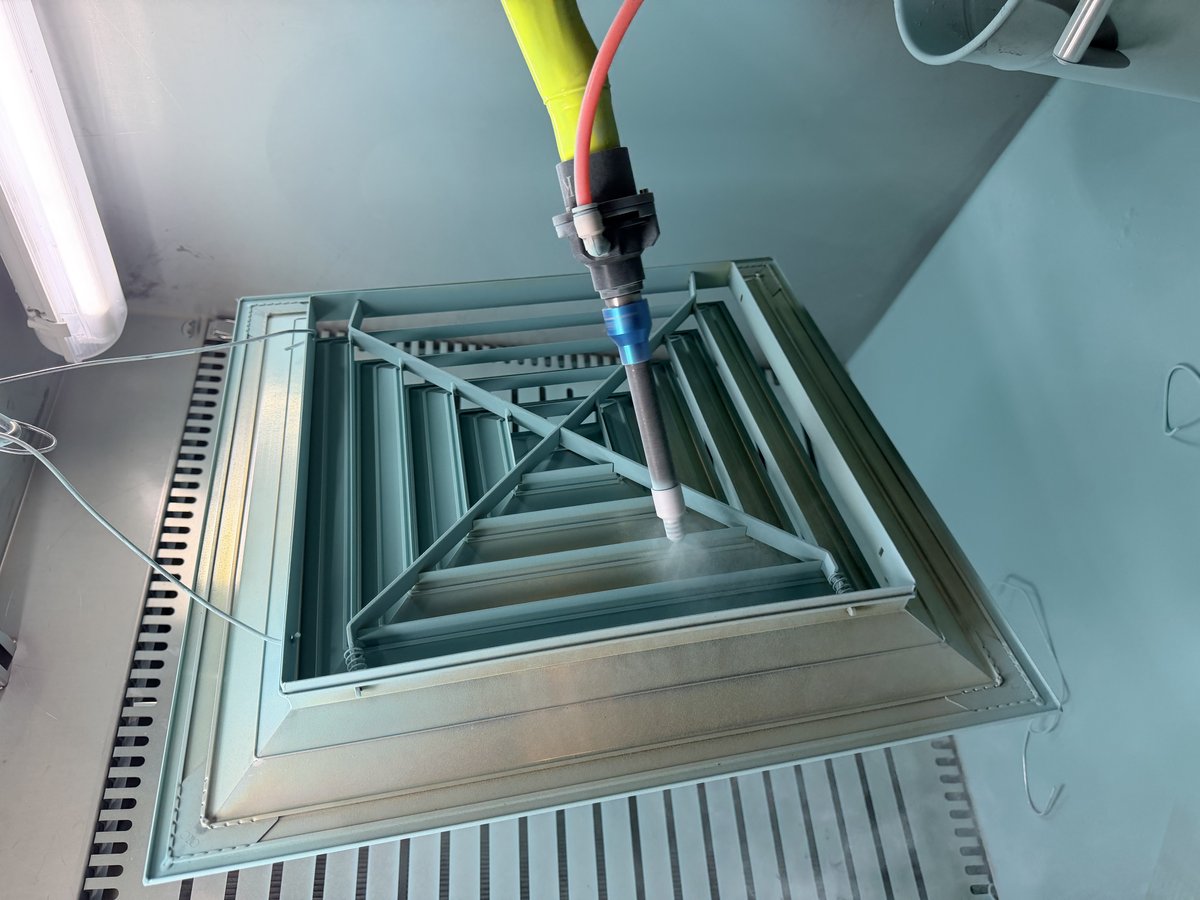
Common applications where the Faraday Cage Effect is most problematic: - Automotive body panels and bumpers - Electrical enclosures and junction boxes - Metal furniture frames and chair legs - Agricultural equipment chassis - HVAC components and ductwork - Racking and shelving systems
Why Conventional Powder Coating Guns Struggle
Traditional corona discharge spray guns operate by charging powder particles as they pass through a high-voltage electrode. This method is highly effective on simple, flat surfaces. But when applied to complex geometries, two major problems emerge:
1. Back-ionization
At high voltage, excess ions accumulate on already-coated areas of the part. This creates a repelling effect that pushes subsequent powder away — compounding the Faraday Cage problem and causing orange peel texture defects on exposed surfaces.
2. Limited penetration force
Electrostatically charged particles are guided primarily by the electric field. In recessed areas where the field is weak or absent, the particles simply have no directional force to carry them into the cavity. Increasing gun voltage makes this worse, not better — higher voltage strengthens the field on exterior surfaces and further starves interior recesses.
This is why operators often try to compensate by moving the gun closer to recessed areas or increasing powder flow — neither of which reliably solves the underlying problem, and both of which typically increase powder waste.
Strategy 1: Precise Voltage and Current Control
The first and most critical strategy is to lower the voltage, not raise it, when coating complex parts.
This is counterintuitive but well-established in industrial coating science. Reducing the output voltage from the typical 80–100 kV range down to 30–60 kV for complex geometries produces a weaker but more evenly distributed electrostatic field. This allows powder particles to penetrate recesses more effectively, rather than being concentrated on outer edges.
Key parameters to control:
- Output voltage: Reduce for complex parts; increase for flat surfaces
- Current (microamperes): Lower current reduces back-ionization; target 10–30 µA for heavily recessed parts
- Powder cloud density: A thinner, more diffuse powder cloud penetrates recesses better than a heavy, concentrated spray
Modern QXD powder coating equipment provides precise digital control over both voltage and current independently, allowing operators to dial in the exact parameters for each specific part geometry. This level of control is essential for consistent results across mixed production runs.
Practical tip: When coating a part with both flat exterior surfaces and deep recessed areas, consider a two-pass approach: first coat recessed areas at low voltage, then apply a finishing pass at higher voltage for the exterior surfaces.
Strategy 2: Advanced Airflow Management
Electrostatic force alone cannot carry powder into the deepest recesses of complex parts. This is where airflow becomes the second critical variable.
Powder particles have mass. In areas where the electrostatic field is weak, mechanical force — delivered through precisely controlled airflow — can carry particles where electricity alone cannot.
Two airflow principles that help overcome the Faraday Cage Effect:
A. Increased carrier air velocity
By increasing the velocity of the carrier air stream, powder particles gain enough kinetic energy to penetrate recessed areas even when the electrostatic attraction is weak. The key is balance: too much air velocity disrupts the powder cloud and causes turbulence; too little leaves recesses uncoated.
B. Optimized spray pattern geometry
Flat fan spray patterns are efficient for flat surfaces but poorly suited to recesses. A narrower, more focused spray pattern concentrates airflow and powder into cavities. Some advanced guns allow pattern shape adjustment between round (for recesses) and flat fan (for flat surfaces).
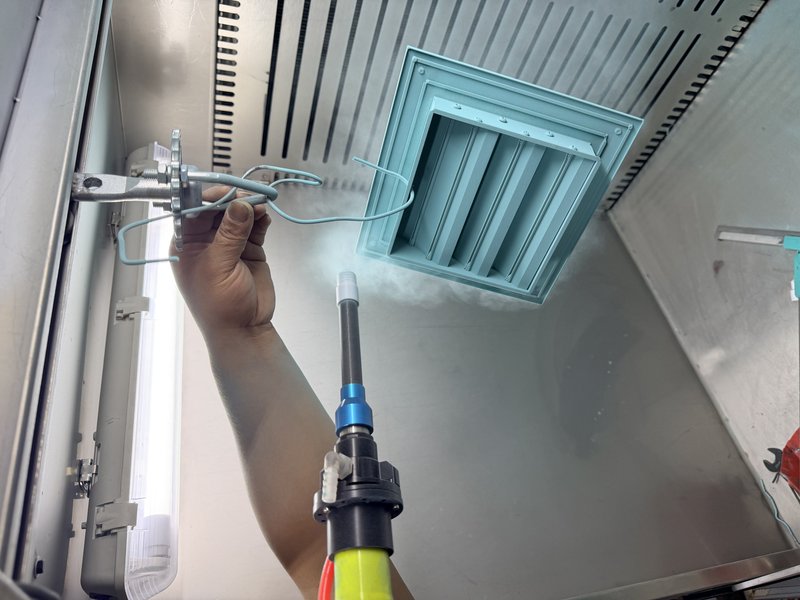
QXD coating systems are engineered with adjustable airflow dynamics that allow operators to independently tune carrier air pressure, pattern shape, and flow rate — giving full control over the mechanical delivery of powder independent of the electrostatic parameters.
Strategy 3: Rotary Atomization Technology

The most significant advance in overcoming the Faraday Cage Effect is rotary atomization — the technology at the heart of the QXD Q-Series powder coating machines.
Unlike corona discharge guns that rely purely on electrostatic attraction, rotary atomization uses centrifugal force to atomize and project powder particles. Here's how it works:
- Powder is fed onto a high-speed rotating bell or cup (typically spinning at 10,000–40,000 RPM)
- Centrifugal force atomizes the powder into a fine, uniform cloud
- The rotating geometry creates a wrap-around spray pattern that envelops complex part geometries
- Electrostatic charge is applied simultaneously, but the mechanical projection force means particles don't rely solely on the electrostatic field for directional guidance
Why rotary atomization outperforms conventional guns on complex parts:
| Factor | Corona Discharge Gun | Rotary Atomization (QXD Q-Series) |
|---|---|---|
| Penetration into recesses | Limited by field lines | Enhanced by centrifugal projection |
| Back-ionization risk | High at elevated voltage | Significantly reduced |
| Transfer efficiency | 60–70% typical | 85–95% achievable |
| Particle size uniformity | Variable | Highly uniform |
| Wrap-around coverage | Poor | Excellent |
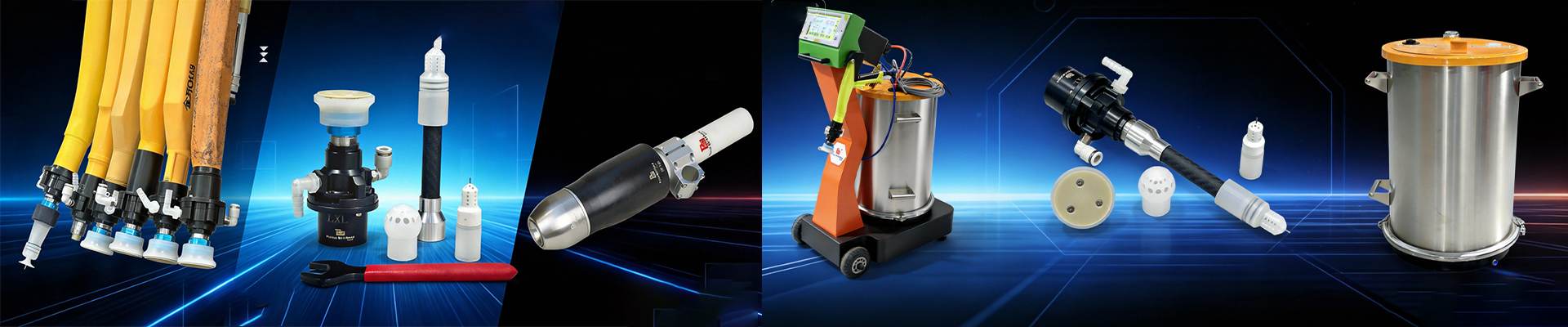
The QXD Q7 handheld electrostatic powder coating machine incorporates rotary atomization specifically engineered for complex part geometries. Unlike fixed-line automated rotary systems, the Q7's handheld design allows operators to position the rotating head precisely at the optimal angle and distance for each specific recess or cavity — combining the advantages of rotary technology with the flexibility of manual operation.
In production environments where customers have switched from conventional guns to the QXD Q7, reject rates from Faraday Cage Effect failures have been reduced by 35–45%, with corresponding reductions in powder waste and rework labor.
Combining All Three Strategies: A Practical Workflow
For the most challenging parts — deep cavities, tight corners, complex three-dimensional geometries — the most effective approach combines all three strategies in a structured workflow:
Step 1: Part preparation
Ensure proper grounding. Poor or inconsistent grounding dramatically worsens the Faraday Cage Effect. Check ground connections and clean contact points before each production run.
Step 2: Parameter setup for recesses
Set voltage to 40–60 kV and current to 15–25 µA. Increase carrier air pressure by 15–20% compared to flat surface settings.
Step 3: Recess coating pass
Using the QXD Q7, position the rotating head at 15–20 cm from the recess opening. Use a slow, deliberate motion to allow the centrifugal spray pattern to wrap into the cavity. Apply until recess surfaces show visible powder coverage.
Step 4: Exterior coating pass
Increase voltage to 70–80 kV for flat exterior surfaces. Reduce carrier air to standard settings. Complete the exterior coating with normal technique.
Step 5: Quality check before cure
Under UV or raking light, visually inspect recessed areas for coverage uniformity before sending parts to the oven. Touch-up at this stage costs seconds; after cure, a rework cycle costs hours.
Frequently Asked Questions
Q: Can I overcome the Faraday Cage Effect just by increasing the voltage on my existing gun?
A: No — increasing voltage typically makes the problem worse. Higher voltage strengthens the electrostatic field on outer surfaces, which further prevents powder from penetrating recesses. Reducing voltage combined with adjusted airflow is the correct approach.
Q: How much does transfer efficiency improve when switching to rotary atomization?
A: In typical industrial applications with complex parts, transfer efficiency improvements of 20–30 percentage points are common when switching from conventional corona guns to rotary atomization systems like the QXD Q-Series.
Q: Is rotary atomization suitable for all powder types?
A: Rotary atomization works effectively with most standard thermosetting powder coatings, including epoxy, polyester, epoxy-polyester hybrid, and polyurethane chemistries. Very coarse or metallic powders may require parameter adjustment.
Q: Can the Faraday Cage Effect be completely eliminated?
A: On extreme geometries — very deep narrow tubes or fully enclosed cavities — complete elimination is not always achievable with powder coating alone. However, with proper technique and rotary atomization technology, the effect can be reduced to the point where it no longer causes functional coating failures in the vast majority of industrial applications.
Q: What is the minimum recess geometry that the QXD Q7 can effectively coat?
A: The Q7 has been tested on recesses as narrow as 40mm width with 80mm depth. For geometries beyond this ratio, combined strategies including airflow optimization and multi-pass technique are recommended.
Conclusion
The Faraday Cage Effect is one of the most technically challenging problems in industrial powder coating — but it is manageable with the right approach. The three strategies outlined in this guide — precise voltage and current control, advanced airflow management, and rotary atomization technology — address the problem at its root rather than masking its symptoms.
For manufacturers dealing with complex part geometries, investing in equipment specifically designed to overcome electrostatic limitations is not just a technical upgrade. It translates directly into fewer rejected parts, less powder waste, reduced rework labor, and higher throughput.
The QXD Q7 handheld electrostatic powder coating machine was engineered specifically for these challenges. If you are currently experiencing Faraday Cage Effect problems in your production line, contact the QXD Coating team to discuss how our rotary atomization technology can be applied to your specific application.
Related Articles: - How a Rotary Powder Coating Head Helps Improve Coating in Faraday Cage Areas - How Rotary Bell Spray Technology Improves Powder Coating Efficiency
Related Products: - QXD Q7 Handheld Electrostatic Powder Coating Machine - QXD Q2 Automatic Powder Rotary Cup Spray Gun
QXD Coating | Dongguan Paint Brothers Spray Equipment Technology Co., Ltd
www.qxdcoating.com | jerry@qxdcoating.com